
Tento článok zatiaľ nemá slovenskú verziu — nižšie ho nájdete v angličtine.
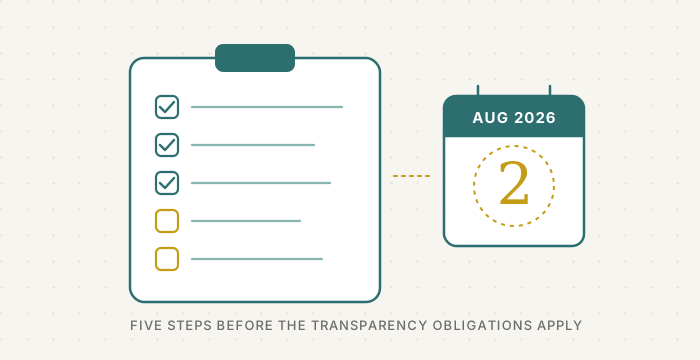
From 2 August 2026, the transparency obligations in Article 50 of the EU AI Act start to apply. If your charity uses an AI chatbot on its website, or publishes AI-generated content, this affects you — even if you're small, even if you never think of yourself as a "tech organisation".
This article explains what changes, who it applies to, and gives you a practical five-step checklist to get ready. It is written for people who run charities, not for lawyers.
This article is general information, not legal advice. It does not constitute legal advice, and Vedomia does not provide legal services. For legal questions about your specific situation, speak to a qualified solicitor.
What changes on 2 August 2026
The EU AI Act is being phased in over several years. The part that matters most for everyday organisations — Article 50, the transparency obligations — has applied since 2 August 2026.
In plain terms, Article 50 is about one simple idea: people have a right to know when they are dealing with AI.
The obligations most relevant to charities and nonprofits are:
- If people interact with an AI system (like a chatbot), they must be informed that they are talking to AI — unless it is already obvious from the context. "We assumed people would guess" is not a plan.
- AI-generated or AI-manipulated images, audio and video must be disclosed as such. If you publish a synthetic image or video, people need to be able to tell.
- AI-generated text published to inform the public on matters of public interest must be disclosed — unless the text has gone through human review and someone in your organisation takes editorial responsibility for it.
There are further obligations for organisations using things like emotion recognition systems — rare in the charity sector, but if that's you, look at Article 50 closely.
That's the core of it. Not a mountain of paperwork — a duty to be honest about where AI shows up in how you communicate and operate.
"But we're a charity, surely this doesn't apply to us?"
The AI Act doesn't have a charity exemption. What matters is not your legal form but what you actually do:
- You have a chatbot on your website answering questions from service users, donors or volunteers → Article 50 applies to that interaction.
- You use AI to draft newsletters, reports, campaign materials or social posts → depending on how they're reviewed and published, disclosure duties can apply.
- You use AI-generated images or video in campaigns → disclosure applies.
- A supplier runs AI on your behalf (an outsourced helpdesk bot, an AI-powered donor platform) → you can't outsource the responsibility to be transparent with your own service users.
And there is a second reason this matters, beyond the regulation itself: charities run on trust. Your funders, your donors and the people who use your services are already asking whether that email, that report, that answer came from a person or a machine. Being able to answer clearly is worth more than avoiding a fine.
The gap nobody has filled
If you search for guidance on this today, you'll find law firm briefings written for multinationals, and AI policy templates from UK and US organisations that don't reflect the Irish and EU context. There is very little written for an Irish community organisation with twelve staff, three funders and a chatbot it set up last year.
That's exactly the gap this article — and the free template below — is meant to close.
This is a process question, not a technology question
Here is the idea that makes everything below simpler: AI never works alone. A chatbot lives inside your communication process. An AI-drafted application lives inside your grant process. An AI suggestion lives inside a decision about a person. So when the law asks you to be transparent about AI, it is really asking a process question: can you show, step by step, where AI enters your work — and who checks it?
This is not just our framing. Every serious framework converges on it. The AI Act's own record-keeping and human-oversight provisions assume you can point to the step where AI acts and the step where a human intervenes. The NIST AI Risk Management Framework puts it bluntly: "without contextual knowledge, and awareness of risks within the identified contexts, risk management is difficult to perform." ISO/IEC 42001 — the international standard for managing AI — is, at its core, a documented-process standard.
And the reverse is well documented too. A Dutch court stopped the state's SyRI welfare-fraud system precisely because nobody could show how it reached its decisions — an invisible process made the system legally indefensible, whatever the algorithm did. An AI model is already hard to explain; placed inside an undocumented workflow, it becomes a black box inside a black box. Nobody can say where a decision came from, so nobody can stand behind it.
There is one more reason to take this seriously: AI is an amplifier. It speeds up whatever process it is dropped into — including a messy, unmapped one. Automating a process nobody has looked at doesn't fix it; it multiplies its errors across hundreds of interactions, faster than anyone can catch them. For an organisation that runs on trust, that is the real danger of "we just started using it" — not the fine.
The good news: the fix is not expensive, and you already own everything it requires. It is the same pattern throughout: map the process → see where AI enters → make that step visible → keep the evidence. The checklist below is that pattern, applied.
Five-step readiness checklist
You don't need a consultant to start. You need an honest afternoon. Here's the order we'd suggest:
Step 1 — Make a list of everywhere you use AI
Not just the obvious chatbot. Ask every team: what tools do we use that generate text, images, summaries, translations or recommendations? Include tools inside other tools (AI features in your CRM, your email platform, your design software). You cannot be transparent about what you haven't seen. Write it down — one row per use, in a simple table.
Step 2 — For each use, ask: does a person we serve ever encounter this?
Split your list in two. Internal uses (AI helping staff draft a first version of a funding report that a human rewrites) carry different weight than external uses (a chatbot talking directly to a service user, an AI-generated image in a campaign). The external uses are where Article 50 bites first.
Step 3 — Check what people are actually told
Open your website as a visitor. If your chatbot greets someone, does it say it's automated? If you publish AI-assisted content, would a reader know? Compare what your policies say with what a person actually sees on screen. In our experience, this is where the biggest gaps hide — the document exists, but the human in front of the system was never told anything.
Step 4 — Decide and document your human oversight
For each AI use, name who reviews the output, what they check, and what happens when the AI gets it wrong. "Someone looks at it" is not documentation. "Maria reviews every chatbot escalation within one working day, and any published AI-assisted text is edited and signed off by the communications lead" — that is documentation. If you're ever asked to show how you supervise your AI, this is what you'll need.
Step 5 — Publish an AI Transparency Statement
Pull steps 1–4 into one short, public, human-readable page: where you use AI, why, what data it touches, who oversees it, what its limits are, and who to contact with questions. Put it on your website. Date it. Review it when your tools change. This single page does more for trust — with funders, donors and service users — than any internal policy no one reads.
We've published a free, fillable AI Transparency Statement template for Irish charities you can use for step 5 — no sign-up needed. It's included in full at the end of this article.
How Vedomia can help
Vedomia is an Irish company focused on one thing: helping organisations make their processes and their use of AI visible, explainable and auditable. We work mainly with charities, nonprofits and publicly funded organisations.
Two things you can use right now:
- Transparency Self-Audit (free). Around 20 questions across four pillars — Visibility, Sequence, Justification, Auditability. It helps you see how transparent your processes and AI use actually are, and identifies transparency gaps before someone else does.
- Vedomia Workspace. Map one real process once and keep it alive in a private Workspace — €99 for 12 months — or set up your whole organisation with a 90-minute onboarding for €450: one living model that your team, funders, auditors and the people you serve can all read, including where and how AI is used.
To be clear about what we do and don't do: Vedomia supports readiness, helps you document your AI use, and identifies transparency gaps. We do not certify compliance, and nothing we provide guarantees legal conformity. This is not legal advice — where you need a legal opinion, we'll be the first to say so.
But most charities don't need a legal opinion to get started. They need to know where their AI is, what people are told about it, and what to fix first. That part, you can begin today.
Start with the free Transparency Self-Audit, or use the AI Transparency Statement template below. Article 50 now applies — the sooner your disclosures are in place, the better.
Free template: AI Transparency Statement for Irish charities
A free, fillable template from Vedomia. Use it to tell the people you serve — and your funders, donors and board — where and how your organisation uses AI.
From 2 August 2026, the transparency obligations of Article 50 of the EU AI Act apply, including the duty to tell people when they are interacting with AI. A clear, public statement like this one helps you document your AI use and supports your readiness. It is a template, not a legal document — it does not constitute legal advice, and completing it does not by itself ensure compliance with any law.
How to fill this in (read first — 5 minutes)
- Write for a service user, not a lawyer. If your receptionist couldn't explain a sentence to a visitor, rewrite it.
- Only describe AI you actually use. Don't copy generic wording. An honest short statement beats an impressive vague one.
- One row per AI use in section 1. A chatbot and an AI drafting tool are two separate rows, even if they come from the same supplier.
- Be specific about human oversight. Name roles (not necessarily people) and describe what they actually check.
- Publish it on your website where people can find it (e.g. linked from your footer or your privacy page), date it, and review it whenever you add, remove or change an AI tool — at minimum once a year.
- Text in [square brackets and italics] is instructions or examples — replace or delete it before publishing.
AI Transparency Statement
Organisation: [Full organisation name, e.g. Example Community Trust CLG]
Registered charity number (RCN): [if applicable]
Statement last updated: [date — update every time the content changes]
Why we publish this statement
[One or two honest sentences in your own voice. Example: "We use a small number of AI tools to help us work more efficiently. We believe the people we serve have a right to know where AI is involved, what it does, and who is responsible — so we publish and maintain this statement."]
1. Where we use AI
[One row per AI use. Delete example rows before publishing.]
| Where you'll encounter it | What the AI does | Does it make decisions about you? |
|---|---|---|
| [e.g. Website chatbot] | [Answers common questions about our services and opening hours] | [No — it provides information only; a staff member handles anything it can't answer] |
| [e.g. Newsletters and reports] | [Helps our staff draft first versions of some texts] | [No — every published text is reviewed and edited by a named staff member] |
| [e.g. Translations] | [Translates some materials into other languages] | [No — important translations are checked by a person] |
2. Purpose — why we use it
[Plain sentences, one per use. Example: "We use the chatbot so that people can get answers to simple questions outside office hours. We use AI drafting tools so our small team can spend less time on paperwork and more time with the people we serve."]
3. What data the AI processes
[For each use, say what information the tool receives and whether personal data is involved. Example: "The chatbot processes the text of the question you type. Please do not enter sensitive personal details into the chatbot — if your question involves personal circumstances, contact us directly at [contact]. Our AI drafting tools do not process service-user personal data."]
[If personal data is processed, link to your privacy notice here and make sure the two documents agree with each other.]
4. Human oversight — who checks the AI
[This is the most important section. Be concrete. Example: "The chatbot's answers are drawn from content written and approved by our staff. Our [office coordinator] reviews chatbot conversations weekly and corrects wrong or unclear answers. Any AI-assisted text we publish is reviewed, edited and approved by [the communications lead] before publication — a person, not the AI, takes responsibility for what we publish. No decision about a person's services, funding or eligibility is made by AI."]
5. Limits — what our AI cannot do
[Honest limits build trust. Example: "The chatbot can only answer questions about topics it has been given content for; it can be wrong, and it does not know your personal situation. AI-generated drafts can contain errors, which is why we review them. Our AI tools cannot access your personal records."]
6. Questions, concerns and complaints
[Give people a real route to a human. Example: "If you are unsure whether you are dealing with AI, if you think an AI tool gave you wrong information, or if you want a human to review something: contact [name of role] at [email] or [phone]. We will respond within [X] working days. You can always ask to deal with a person instead of the chatbot."]
Contact point: [role, email, phone]
7. Changes to this statement
[Example: "We review this statement whenever we add, change or stop using an AI tool, and at least once a year. Previous versions are available on request."]
About this template
This template was created by Vedomia (vedomia.com), an Irish company that helps charities, nonprofits and publicly funded organisations make their processes and AI use visible, explainable and auditable.
It follows the structure Vedomia uses in its AI Transparency Statement work: where AI is used, purpose, data, human oversight, limits, contact, and date of last update.
Want to know where your gaps are before you publish? Take Vedomia's free Transparency Self-Audit — around 20 questions that help you see how transparent your processes and AI use are, and identify transparency gaps. It supports your readiness for the EU AI Act's transparency obligations; it does not certify compliance and does not constitute legal advice.
This article is general information about the EU AI Act and does not constitute legal advice.
Prepared with the help of an AI assistant, reviewed by Sandra Fedakova.
Want to see where your transparency gaps are before 2 August 2026?
Take the Free Transparency Self-Audit