
Imagine your organisation has just completed a successful EU-funded project. The work was done, the outcomes were delivered, the final report was submitted. Then, during a routine check, the managing authority flags a problem: your organisation did not consistently display the EU emblem on your project materials. The phrase "Funded by the European Union" was missing from your website.
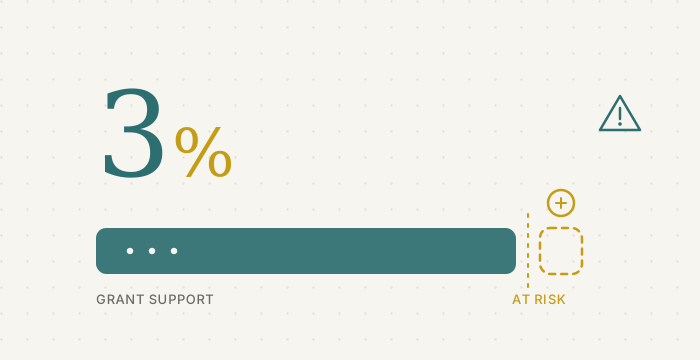
The managing authority applies a financial correction. Under Regulation (EU) 2021/1060, Article 50(3), they are entitled to cancel up to 3% of the EU support for the operation.
On a grant of €500,000, that is €15,000 gone — not because the project failed, but because a logo was missing.
This is not a theoretical risk. It is a documented enforcement mechanism that most NGO and charity grant managers are completely unaware of.
"Where the beneficiary does not comply with its obligations under Article 47 or paragraphs 1 and 2 of this Article, and where remedial actions have not been put into place, the managing authority shall apply measures, taking into account the principle of proportionality, by cancelling up to 3 % of the support from the Funds to the operation concerned."
For Interreg programmes, the cap is 2% under Article 36 of Regulation (EU) 2021/1059 (the Interreg-specific regulation).
What the regulation actually requires
The visibility and communication obligations for EU-funded organisations are set out in Annex IX of CPR 2021/1060. They are more specific than most people realise.
First, every beneficiary of EU structural funds must display the Union emblem alongside a written statement. The statement must be either "Funded by the European Union" or "Co-funded by the European Union" — and critically, it must be written in full. An abbreviation, a logo alone, or the words "EU funding" do not satisfy this requirement.
Second, the requirements escalate based on the scale of the project:
| Situation | Funds | Required action |
|---|---|---|
| Total cost of operation exceeds €500,000 | ERDFCohesion Fund | Permanent plaque or billboard at the project site, bearing the Union emblem |
| Total cost of operation exceeds €100,000 | ESF+JTFEMFAFAMIFISFBMVIInterreg | Permanent plaque or billboard at the project site, bearing the Union emblem |
| Below the relevant threshold | All funds | At minimum, one A3 poster (or equivalent electronic display) in a location visible to the public |
These are not optional good practices. They are legal obligations that can trigger financial penalties if not met.
Why so many organisations get this wrong
The European Court of Auditors published Special Report 11/2025 on the transparency of EU funding granted to NGOs. Its findings were stark: obtaining a reliable picture of all EU funds received by a single NGO is, in the auditors' own words, "practically impossible" — because information is published in a fragmented way across multiple systems.
That fragmentation is not just a problem for auditors. It reflects a deeper systemic issue: organisations receive guidance from managing authorities in different formats, in different languages, at different levels of clarity. Many NGOs and charities operating across borders receive conflicting signals about what is required.
The ECA's audit also found that EU fund managers rely mainly on self-declarations to verify compliance, rather than proactively checking. This creates a false sense of security. Beneficiaries assume that if nothing was flagged during the project, there is no problem. But checks can happen retrospectively — and when they do, the consequences apply to completed work, not future projects.
Visibility is not the same as transparency
It is worth being precise about what the regulation is actually demanding. The EU visibility requirements — logos, plaques, the correct wording — are about visibility. They help citizens trace public money. They are important, and they are legally enforced.
But they are not the same as transparency.
An organisation can meet every visibility requirement exactly and still be opaque in the ways that matter most to its beneficiaries, its staff, and the communities it serves. A billboard with the correct emblem tells a citizen that EU money was spent here. It tells them nothing about how decisions were made, how funds were allocated, whether complaints can be raised, or whether the organisation can be held accountable.
Transparency is not the act of displaying the right logo. It is the act of making information genuinely understandable — including information about how your organisation works.
The 3% rule protects the first category. The work of building genuinely transparent organisations — the kind that build lasting trust with funders, beneficiaries, and communities — is a separate task, and one that requires a different kind of attention.
A practical checklist before your next audit
If your organisation receives or manages EU structural funds, the following questions are worth reviewing now — not at the point of a compliance check:
- Does every public-facing document related to the funded project display the Union emblem and the full written statement?
- Is the phrase "Funded by the European Union" or "Co-funded by the European Union" written in full — not abbreviated?
- Does your project website or social media presence include a short description of the operation with the EU financial contribution acknowledged?
- If the total cost of your operation exceeds the relevant threshold (€500k for ERDF/CF, €100k for ESF+ and others), is a permanent plaque or billboard in place at the project site?
- If below the threshold, is there at minimum one A3 poster in a publicly visible location?
- Are these materials documented — photographed, archived — in a way that can be produced during an audit?
Meeting these requirements protects your grant. But it is the beginning of transparency, not the end of it.
How transparent is your organisation, really?
Our free Transparency Audit gives you a scored assessment across 20 questions covering governance, financial transparency, communications, and EU compliance — with a practical report and document templates.