
For three years I worked inside an Irish local development company, building quality and information systems for programmes co-funded by the European Union. Capable people, real work, money that reached people who needed it.
And every few months, the same scene. Somebody would ask a reasonable question — why was this decided that way, who signs this off, which document proves it — and the answer would take two days to assemble. Not because anyone was hiding anything. Because the answer lived in eleven places and nobody had ever written it down in one.
I kept thinking somebody would have done it already. I went looking. They had not.
The EU publishes a great deal. It publishes the wrong half.
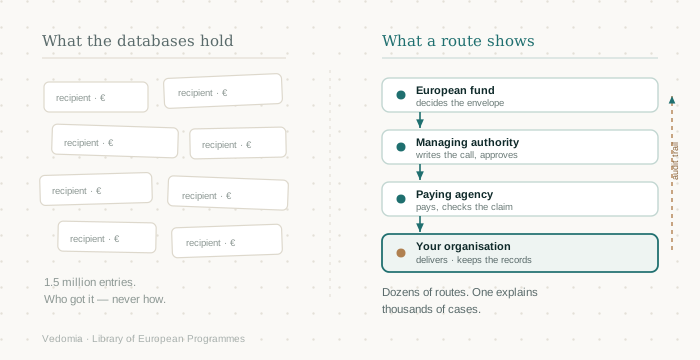
This is not a complaint about secrecy. The European Commission runs Kohesio, a database of more than 1.5 million projects and around 500,000 beneficiaries. There is a Financial Transparency System for funds the Commission manages directly. These are real achievements and a lot of work went into them.
They answer one question: who received public money, and how much.
They do not answer the other one: how did it get there, and who was answerable at each step.
A list of recipients is a record of an outcome. It is not a route. If you are an organisation thinking of applying, knowing who won last year tells you nothing about what is expected of you, in what order, or who decides. If you are a citizen, you can see where the money landed. You cannot see how it flew.
The EU’s own auditors say the same thing
I want to be careful here, because it would be easy to sound like I am accusing someone. I am not. The finding is on the record.
In Special report 11/2025, the European Court of Auditors examined transparency of EU funding granted to NGOs. Between 2021 and 2023, more than 12,000 organisations received €7.4 billion. The auditors found that information about this funding is published in a fragmented way that hinders transparency and analysis, and that no reliable overview exists.
The trail of public money is not hidden. It is scattered. It sits across regulations, calls, national rules, agency procedures and managing-authority documents — each one correct, none of them joined up. A person of ordinary patience cannot assemble it, and should not have to.
Two numbers that changed how I think about this
Cohesion policy holds €392 billion for 2021–2027. That is close to a third of the entire EU budget.
Only 40% of EU citizens know about an EU-funded project in their own region. That figure has barely moved since 2019.
But here is the part that stopped me. Among the people who do know about those projects, 79% say the impact on their region is positive.
Put those two beside each other. People who know about this work think well of it. So the problem is not what is being done. The problem is that it cannot be followed.
That reframed the whole thing for me. I had assumed the gap was trust. It is not. The gap is legibility — and mistrust is what grows in the space where an explanation should be.
Why routes, and not more data
The instinct when something is unclear is to publish more. I think that instinct is wrong here, and this is the one genuinely technical idea in this piece.
Kohesio holds 1.5 million projects. Nobody reads 1.5 million of anything. But the routes those projects travel number in the dozens. LEADER works one way. ESF+ works another. A route is stable, and it repeats for every project that passes through it.
Map one route, and you have explained thousands of cases at once.
That is the difference between an archive and a map. An archive answers you once you already know what to ask. A map teaches you what to ask.
What each map actually shows
For every programme in the library, the chain is drawn: from the European fund down to the office that signs your agreement.
- Who is in the chain — every body the money passes through.
- What each one does — decides, pays, checks, monitors. Actions, not job titles.
- Where your organisation sits — marked, so you can see who is above and below you.
- How the audit trail runs — upwards, from your own records. Not downwards from Brussels. This is the part people most often have backwards, and getting it backwards is expensive.
- Which bodies stand beside the chain rather than in it — a national audit office, OLAF, the European Public Prosecutor. They can enter at any point. They are not steps.
The part I am most careful about
Every map says which document it was read against, and on what date. Sources carry a grade: binding regulation, official methodological document, or secondary official page.
And where I could not confirm something at the primary source, the map says so. In plain words. Instead of guessing.
That last decision is the one that takes the time, and it is the one I would defend hardest. A map that admits a gap can be checked by the reader. A map that quietly fills the gap cannot — and the reader has no way of knowing which kind they are holding.
Why this matters beyond my own work
For a citizen: when something goes wrong and you do not know who decided, there is nobody to ask. Accountability needs an address. A route gives it one.
For an organisation: the error rate in cohesion spending was 5.7% in 2024. The most common errors are ineligible costs and breaches of procurement rules. In my experience that is almost never dishonesty. It is somebody who did not know which step needed which record. A visible route prevents that before it becomes a financial correction — which is public money saved, directly.
And for fairness: people who do not understand a system do not apply to it. Small municipalities and organisations often never go for money they are entitled to, because the path looks impassable. The money then goes where there is a consultant on the payroll. A published route narrows that gap.
Where it stands
Twenty-seven programme routes, across Ireland and Slovakia. More than eighty links to primary and official sources. Free to read, no account, in English and Slovak.
It grows one programme at a time, because each one has to be read before it can be drawn. That is slow, and I have made my peace with it being slow.
Universities, researchers and public bodies are welcome to use the maps and build on them — the only thing asked is that the source is named, with the date it was checked. The citation is on the library page, ready to copy.
I built this because I needed it myself and it did not exist. If it saves somebody else those two days, that is the whole point.