
It is Tuesday morning. The board meeting is in three weeks. Your EU managing authority has requested a desk audit of your management and control system, and you have just discovered that the person who knew where all the documentation was kept left six months ago. Her desk instructions are on a USB stick somewhere. Her delegation matrix exists, possibly, in an email thread from 2022. Her successor has been doing the job admirably by asking colleagues in corridors and reverse-engineering decisions from their outcomes.
You are not incompetent. Your organisation is not corrupt. You care deeply about the people you serve, and by any honest reckoning you are doing important work. But right now, looking at the audit request on your screen, you feel the particular dread of someone who has been building on sand and only just noticed.
This is not a story about compliance failure. It is a story about a category error — one that almost every social sector organisation makes, and one that costs them in ways they do not always connect to its source. The category error is this: treating processes as bureaucratic overhead rather than as the primary substance of what an organisation is and does.
The process audit fixes this. Not by adding paperwork. By revealing truth.
Processes Are Not Paperwork. They Are Promises.
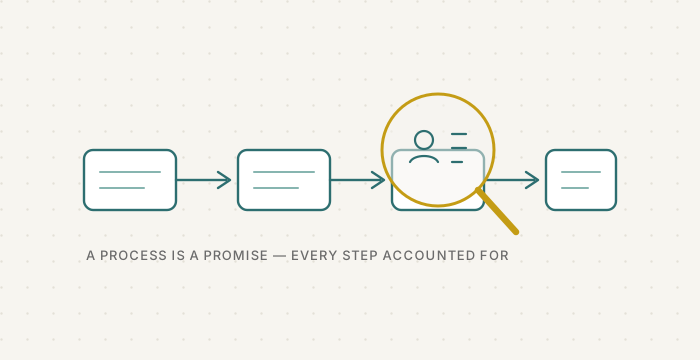
Here is the framing that changes everything. A process is not a document. A process is a series of promises about how your organisation will behave — not in your strategic plan, not in your annual report, but in the moments that actually happen. The promise you make when someone calls your helpline at 4pm on a Friday. The promise embedded in how long your intake form is, and what it asks, and what it implies about your view of the person filling it in. The promise made by whether your frontline worker sits behind a large desk or across a small table.
These promises are kept or broken regardless of your intentions. They are made regardless of whether you have written them down. The only question the process audit answers is: are you making the promises you think you are making?
"A program can talk fluently about trauma and still re-traumatize clients through its waiting-room layout, intake paperwork, security posture, or supervisory style." — Trauma-informed care practitioner literature on institutional design
Tom Tyler's fifty years of research on procedural justice established something that should be required reading in every NGO director's induction: when people evaluate an authority — a caseworker, a social service, an organisation — they weight procedural fairness more than outcome favorability. The public is especially concerned that the conduct of authorities be fair, and this factor matters more to them than whether outcomes of particular interactions favor them. People can be told no. What they cannot tolerate is being made to feel invisible, suspect, or disposable while being told no.
This is not a finding about client satisfaction scores. It is a finding about whether your organisation is actually doing what it believes it is doing.
The financial audit checks whether the money went where you said it went. The process audit checks whether the organisation went where you said it was going.
The Invisible Architecture of Who You Are
W. Edwards Deming spent his career demonstrating something that most managers still refuse to believe: 94% of organisational problems belong to the system, and only 6% to the individual. Most performance failures are process design failures, not people failures — yet most managers reach for personnel solutions first.
Think about what this means in practice. The programme manager who "wasn't quite right" and was replaced — twice — before anyone asked whether the role itself was actually defined. The finance officer and programme officer who fought monthly over expenditure approval, each convinced the other was being obstructive, before someone drew a two-page decision authority table and the conflict evaporated. The founding coordinator who held everything in her head — donor contacts, grant deadlines, reporting templates, approval chains — and whose six-month medical leave left the organisation unable to submit a mandatory EU interim report.
None of these are people problems. All of them are process problems dressed in people's clothing.
Process documentation determines what roles you need before you hire for them. You can only write an accurate job description for a process you have defined. Bridgespan's research on 25 national nonprofit networks found that 80% spent adequate time on strategy, but only approximately half invested equivalent attention in their operating model — the blueprint that specifies what roles are needed and why. The result is a sector that hires well and structures poorly, then interprets the structural failures as recruitment failures, then hires again.
Forty percent of new employees report that their job does not match what was described at interview. This is not a recruitment crisis. It is a documentation crisis. The interview described a job that does not exist as a defined set of activities, because the activities were never mapped. The new hire steps into an undefined space and tries to construct the role from ambient signals. Sometimes they succeed. Often, by month four, they have left.
"A bad system will beat a good person every time." — W. Edwards Deming
Google's Project Aristotle studied 180 teams and found something counterintuitive enough to stop conversations: having high-performer individuals on a team actually hindered team performance. Individual talent disrupted the psychological safety norms that produce collective effectiveness. The single strongest predictor of team success was not who was on the team but how the team worked — the process norms that governed communication, error-reporting, and shared accountability.
Amy Edmondson found the same thing in hospitals. Better-performing nursing teams reported more medication errors than lower-performing ones. The difference was not error frequency. It was willingness to surface problems. Safety enabled learning; learning enabled performance. The causal chain is: clear process, psychological safety, learning behaviour, performance. Remove the first element and the chain breaks.
Role ambiguity — the absence of process clarity about what someone is actually supposed to do — is one of the strongest predictors of burnout. Research finds that 66% of individuals experiencing role ambiguity simultaneously report poor emotional wellbeing. But the finding that should give every social sector leader pause is this: role ambiguity spreads. It is contagious through teams by emotional contagion. A team-level climate of ambiguity depresses extra-role performance across the entire group, not just the individual whose role is undefined. The process problem becomes a culture problem becomes a performance problem — and at no point does it announce itself as a process problem.
The 95% of nonprofit leaders who cited burnout as a major challenge in 2025 are not facing a wellness problem. They are facing a systems problem. A sector that treats mission as a substitute for process clarity is not inspiring its people — it is depleting them.
The Emotional Life of a Process
Consider what actually happens when a person in crisis contacts your organisation for the first time.
They have made a decision that cost them something — pride, autonomy, the story they told themselves about not needing help. They are, statistically, already managing reduced cognitive capacity because financial scarcity or mental health crisis or chronic illness narrows executive function in documented, measurable ways. They arrive at your intake process carrying this weight. And then the process begins.
The waiting room layout communicates something before anyone speaks. The intake form communicates something about how much you trust them, and how much you think they can cope with, and whether you view them as a person or a case reference. The handoff between services — whether anyone takes responsibility for continuity or whether they are simply told to contact a different department — communicates whether they matter enough to be accompanied, or merely processed.
Research on care transitions found a patient who voluntarily remained bedbound for twenty hours every week — unable to engage in daily life, unable to move freely — to ensure they would be present when their preferred support worker arrived. The service was technically delivered. The lived experience was confinement. This was not a clinical failure. It was a process failure: the scheduling system was so opaque and unpredictable that the patient had learned the only way to manage it was total physical compliance. When processes are invisible to beneficiaries, they compensate. The compensation costs more than the service was worth.
Turn2us research in the UK found that 1 in 12 people eligible for benefits they are legally entitled to receive use a food bank instead of claiming — not because they do not know benefits exist, and not because they are ineligible, but because the claiming process is experienced as more humiliating than going hungry. Sixty-eight percent feel ashamed seeking support. Over 60% feel the system is trying to catch them out. Fifty-one percent report that the claiming process damaged their mental health. These are not outcomes of a benefit programme. They are outcomes of a process design. The programme worked. The process destroyed people on the way to it.
"It's a very humbling experience, very embarrassing and you feel ashamed, but you're desperate." — Food bank user, University of Aberdeen study, describing the experience of accessing social assistance
The research on administrative burden, developed by Herd and Moynihan, identifies three costs that prevent eligible people from accessing services: learning costs (knowing the programme exists and understanding how to apply), compliance costs (the time and effort required for forms, documentation, and interviews), and psychological costs (the emotional toll of processes that stigmatise or confuse). These costs are not neutral friction. They fall systematically harder on the people who need help most — because the life circumstances that create eligibility simultaneously impair the capacity to navigate application processes. The people most in need of your service are the people your process is most likely to filter out.
The peak-end rule adds a further precision to this. Kahneman and Fredrickson demonstrated that people do not evaluate experiences by their average quality or their duration. They evaluate them by their peak emotional moment and their ending. Duration is almost entirely neglected. This means that a three-hour intake process that ends with a warm, clear, dignified handoff will be remembered more positively than a forty-minute process that ends with an indifferent shrug and a leaflet. Social sector managers optimising for efficiency — shortening processes, combining appointments, reducing contact time — may be optimising exactly the wrong variable. The variable that determines whether a person comes back, engages fully, and achieves the outcomes you are trying to produce, is the emotional peak and the ending. Both are process design choices.
When food pantries switched from handing out pre-packed parcels to letting clients walk the shelves and choose their own food, the food itself did not change. The eligibility did not change. The number of families served did not change. But 79% of pantries making this shift reported improved overall operations. Client food waste dropped. Staff satisfaction rose. Client-reported dignity increased measurably. The same food, delivered through a different process, produced different outcomes. The process was not the delivery mechanism for the programme. The process was the programme.
What You Can Finally Measure
Here is the uncomfortable secret of social impact measurement: most of what passes for evidence in the sector is outcome data that has been severed from its causal roots. You know that 68% of programme completers found employment within six months. You do not know whether that happened because of your programme, or because the labour market improved, or because the people who completed the programme were exactly the people who would have found employment anyway. Without process data, you cannot answer this question. The outcome exists, but it floats free of explanation.
Durlak and DuPre's review of over 500 prevention and health studies found that programmes implemented with high levels of fidelity showed effect sizes two to three times higher than programmes implemented without fidelity monitoring. Not marginally better. Two to three times. And crucially: in science, outcomes cannot be attributed to something that is not there. If fidelity data was not collected, outcome data cannot be attributed to the programme. A programme that appears ineffective in your evaluation may be a perfectly well-designed programme that was never actually delivered as designed. Without process data, the two cases are indistinguishable.
The Washington State Institute for Public Policy examined Functional Family Therapy across therapist cohorts. Therapists in the top 20% of fidelity scores — meaning they followed the process most faithfully — achieved 8% youth recidivism. Therapists in the bottom 20% achieved 34%. The same programme. The same youth population. A four-fold difference in outcomes produced entirely by how faithfully the process was executed. This is not a finding about individual talent. It is a finding about process measurement: the measurement existed, so the variation was visible, so it could be addressed.
Without process measurement, the 34% recidivism outcome would have been averaged in with the 8%, producing a programme-level average that obscured the mechanism entirely. The decision would have been: does this programme work? The process-aware question is: under what conditions does this programme work, for whom, delivered how? Only the second question produces actionable knowledge.
The UK impact evaluation of the European Social Fund 2014–2020 programme found that the social cost-benefit ratio grew from £0.35 per pound invested at 12 months to £1.50 at 36 months — a more than fourfold increase over time. Programmes generate process-level change — skills, confidence, labour market attachment — before outcome-level change appears. Measuring only at programme exit captures 23% of the eventual social return. The rest is invisible to the measurement systems most organisations use.
Process measurement makes duration, intensity, and quality trackable. How many sessions, at what intervals, with what intensity of engagement, delivered by practitioners at what fidelity level. These are the variables that explain whether your programme's outcomes are yours to claim or background noise you are mistaking for signal. SROI ratios constructed without this audit trail are not evidence — they are assertions. A poorly documented 7:1 ratio is less credible than a well-documented 4:1 ratio. The process documentation is what separates social impact evidence from social impact marketing.
There is also something more fundamental at stake. Dignity, long considered unmeasurable as a social outcome, can be tracked through process. A modified Delphi study with 51 long-term care experts produced ten consensus process markers for dignity-conserving care: whether staff make residents feel valued as persons, whether autonomy in daily decisions is preserved, whether complaint mechanisms function without creating fear of retaliation. These are observable, documentable practices. The process is the dignity. And if the process is documented, the dignity can be monitored, reported, and improved.
Why Every Audit, Report, and Funder Relationship Gets Easier
In 2023, the European Court of Auditors found that 9.3% of EU cohesion fund spending was in error — nearly one euro in ten. The Commission's own estimate for the same funds was 2.6%. The gap between what the Commission found and what independent auditors found is not a measurement dispute. It is the size of the invisible process failure zone — errors that financial oversight cannot detect because they live in undocumented procedures, not in financial statements.
ECA Review 03/2024 established something that should be circulated to every managing authority and implementing organisation working with EU structural funds: one in four transactions in audit samples between 2017 and 2022 were affected by some breach of legal requirements, even though almost all had already been examined by national management verification systems. The national verification system was checking whether money moved. The ECA audit was checking whether it moved correctly. The process was the difference.
ECA Special Report 11/2025 examined €7.4 billion disbursed to over 12,000 NGOs from EU internal policy programmes between 2021 and 2023 and found no evidence of fraud or misuse. None. The report is nonetheless a catalogue of transparency failures: wrong classification of organisations, reliance on self-declarations without independent evidence checks, fragmented and incomplete data, undisclosed advocacy activities funded with EU money. The risk in EU-funded civil society is not theft. It is invisibility. And invisibility is a process problem.
"One in four transactions in audit samples between 2017 and 2022 were affected by some breach of legal requirements, even though almost all had already been examined by audit authorities." — ECA Review 03/2024
CPR 2021/1060, the Common Provisions Regulation governing €392 billion in EU cohesion, ESF+, JTF and ERDF funds for 2021–2027, is structurally a process audit framework. Annex XI defines 15 key requirements of management and control systems. Seven of them — covering selection procedures, management verifications, audit strategy, irregularity reporting, and accounting functions — are designated as so critical that failure in any single one constitutes a "serious deficiency" triggering financial corrections. These are not financial requirements. They are process requirements. An organisation that has mapped its workflows to these 15 requirements has pre-built its compliance defence. An organisation that has not has no defence at all, regardless of how honestly it spent the money.
The most frequent type of violation across EU cohesion irregularity findings, year after year, is the same: incorrect, missing, or false documents. Not embezzlement. Not procurement fraud in the criminal sense. Missing documentation. The distinction between "incorrect documents" and "false documents" — between process failure and deliberate fraud — matters enormously for the organisations involved, but from the audit authority's perspective the correction mechanism is the same. The grant gets clawed back.
In Italian 2020 PIF data: 452 non-fraudulent irregular cases worth €57 million, against 26 fraudulent cases worth €22.3 million. By number of incidents, process failure outnumbers fraud 17 to 1. By financial value, process failure costs more than fraud. If your organisation is allocating most of its risk management attention to anti-fraud measures and almost none to process documentation, you are systematically ignoring the larger risk.
The cascade effect of documented processes on reporting and funder relationships is practical and compounding. When processes are documented, reporting becomes a natural output of operational systems rather than a periodic reconstruction exercise. The data that auditors want already exists because it was captured as the work happened. The information that funders need — what was delivered, to whom, with what intensity, with what outcome — is already structured because the process that generated it was already structured. The scramble disappears. Not because you worked harder before the deadline, but because the infrastructure existed before the deadline arrived.
One US nonprofit implementing a monthly internal documentation checklist reduced audit findings by 60% over two years and cut external audit fees by 10% — purely through process improvement, with no change to financial controls. Another organisation that introduced peer review processes and standardised documentation templates eliminated documentation-related audit findings entirely in the year following implementation. These are not exceptional organisations. They are organisations that understood that audit readiness is not a state you achieve in the three weeks before an audit request arrives. It is a state you maintain continuously because your processes make it inevitable.
The Process Audit Is Not the End. It Is the Beginning.
An organisation that has genuinely audited its processes — not ticked a compliance box but actually mapped how decisions get made, how work moves through the organisation, how beneficiaries experience each interaction, how roles connect to outcomes — does not look different from the outside. At first.
What changes is internal. The new programme manager can reconstruct the role from documented materials rather than from corridor conversations. The board can ask the right questions because the management information tells them what the process was supposed to do, not just what the financial outcome was. The funder receives a report that connects daily activities to strategic outcomes because the process documentation makes those connections traceable. The beneficiary arrives at an intake process that was designed — consciously, deliberately — to preserve their dignity at the moments that research tells us matter most.
The process audit creates institutional memory. It is the answer to the founding coordinator who holds everything in her head — not a rebuke of her knowledge but a transformation of it into something the organisation can own rather than borrow. SHRM research finds that 72% of organisations have at least one employee whose sudden departure would significantly impact operations. Lloyd's of London prices key-person insurance policies at an average of £750,000. The financial industry has quantified the risk of undocumented knowledge. Most social sector organisations have not — but they are carrying it regardless.
There is a deeper transformation that takes longer to see. When an organisation's processes are made visible, its values become testable. It is one thing to state in a strategy document that the organisation treats beneficiaries with dignity and respect. It is another thing to map the intake process and ask: at which specific moments does this process communicate dignity? Where does it communicate suspicion? Where does it create waiting without explanation? Where does it ask people to repeat information they have already provided to a different part of the organisation? The gap between stated values and embedded processes is the gap between who an organisation believes it is and who it actually is in the moments that matter.
A process audit does not judge that gap. It reveals it. And once it is visible, it becomes possible to close it — one redesigned touchpoint at a time, one documented decision authority table, one redrafted intake form, one waiting room that stops looking like a holding area and starts looking like somewhere a human being is expected and welcomed.
Deming wrote: "We are being destroyed by best efforts." He meant that heroic individual effort within a broken system is not a solution — it is a way of generating the appearance of solutions while the structural problem compounds. The social sector runs on best efforts. Its people are extraordinarily motivated and frequently exhausted. The processes that could translate that motivation into reliable, scalable, auditable, dignified service delivery are, in most organisations, the thing no one has ever prioritised building.
The strategic plan tells you where you are going. The financial audit tells you whether you spent money getting there. The process audit tells you whether you actually went — and what kind of organisation you were along the way.
Everything else follows from that.
Vedomia Limited works with NGOs, social enterprises, and EU-funded organisations in Ireland, Slovakia, Czech Republic and Poland to build the process infrastructure that makes transparency natural, reporting effortless, and audit readiness permanent.
If this article described your organisation — the USB stick with the desk instructions, the role that has been filled three times, the intake process that no one has ever mapped — our Transparency Systems and Audit Readiness services are the place to start. Not with more paperwork. With the right architecture.