
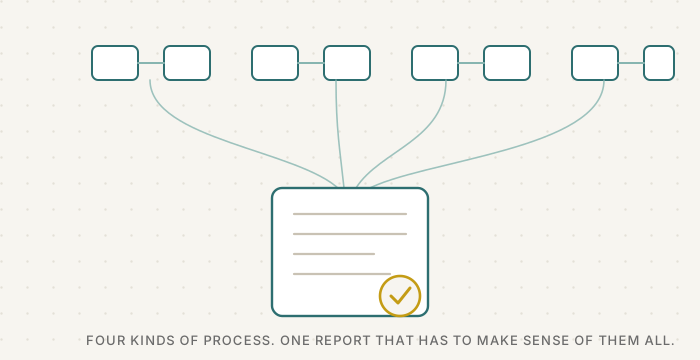
Most organisations doing good work are, underneath, running four very different kinds of process at once. A board sets direction and takes responsibility for how the organisation behaves. Managers turn that direction into an annual plan, check that it's being followed, and fix things when they aren't. Front-line staff deliver the actual service — the referral, the assessment, the support, the outcome. And behind all of it, finance, IT and HR quietly keep the lights on.
None of that is unusual. What's unusual is how rarely anyone notices that a fifth process sits on top of the other four: turning what happened in all of them into something a board, a funder, or a regulator can actually read and trust.
That fifth process is reporting. And almost no organisation treats it as a process at all.
Reporting draws from everywhere
This is what makes reporting harder than it should be. A funder report doesn't just need service numbers — it needs a board decision that authorised the programme, a monitoring note that shows it was checked, a finance figure that reconciles to the accounts, and an HR record that proves the right person delivered it. One document, four different sources, each living in a different part of the organisation, often in a different person's head.
When those four sources are clearly mapped — who owns each step, what evidence it leaves behind — pulling a report together is an afternoon of assembly. When they aren't, it becomes archaeology: emailing three people to ask "do you remember why we did this," hoping the numbers in the board pack match the numbers going to the funder, and quietly smoothing over the bits nobody can quite account for.
Most organisations map their service delivery, eventually — usually because a funder or an audit forces the question. Almost none map reporting itself. It's treated as an inconvenience bolted onto the "real work," not a process with its own owner, its own steps and its own evidence trail. That's the category error. Reporting is not the summary of the work. It is one of the processes.
Six signs of a report that actually works
Not every organisation needs the same reporting cycle. But the reports that don't cause dread in the week before they're due tend to share the same six traits.
- Traceable. Every figure and every claim in the report leads back to a specific record — a form, a ledger entry, a board minute — not to someone's memory of roughly what happened.
- Timely. It's produced on a predictable cadence, because the underlying data is collected as the year goes rather than reconstructed the week it's due.
- Owned. Each section has one named person responsible for it — not "the team," which in practice means no one until three days before the deadline.
- Consistent. The same number means the same thing everywhere it appears — the board pack, the funder report and the annual accounts don't quietly disagree about how many people you helped.
- Honest about gaps. Where something genuinely isn't known yet, the report says so, instead of rounding an estimate into a fact.
- Reusable. This quarter's report is the starting point for next quarter's — a template with fresh numbers dropped in — not a document rebuilt from nothing every single time.
A report that has to be reconstructed from memory isn't evidence of a badly written report. It's evidence of an unmapped process sitting upstream of it.
Map the four, and the fifth gets easier
The fix isn't a better reporting template — though a template helps. It's mapping the processes reporting actually depends on: how governance decisions are recorded, how monitoring and internal review happen, how a service runs from request to outcome, and how the supporting functions — finance, IT, HR — keep their own evidence in order. Once those four are visible, with an owner and a paper trail each, reporting stops being a reconstruction exercise and becomes what it should have been all along: reading off numbers that were already being kept.
We built our free Quality & Evidence Report Builder around exactly this idea — not just service delivery, but the governance, planning and support processes that every report quietly depends on. If you want an honest read on where your own reporting stands before you map anything, our free Transparency Self-Audit takes about ten minutes.
See what your own reporting depends on
Map the process behind any report you produce — free, no sign-up, about ten minutes. Governance, planning, service delivery or support: pick where the gap actually is.