Humanitarian Crisis Response Transparency Map
A human-centred view of responsibilities, decisions, handovers and evidence across a multi-agency response. Built for humanitarian emergencies involving public authorities, NGOs, reception services, legal systems and funding bodies — with the affected person and their dignity at the centre.
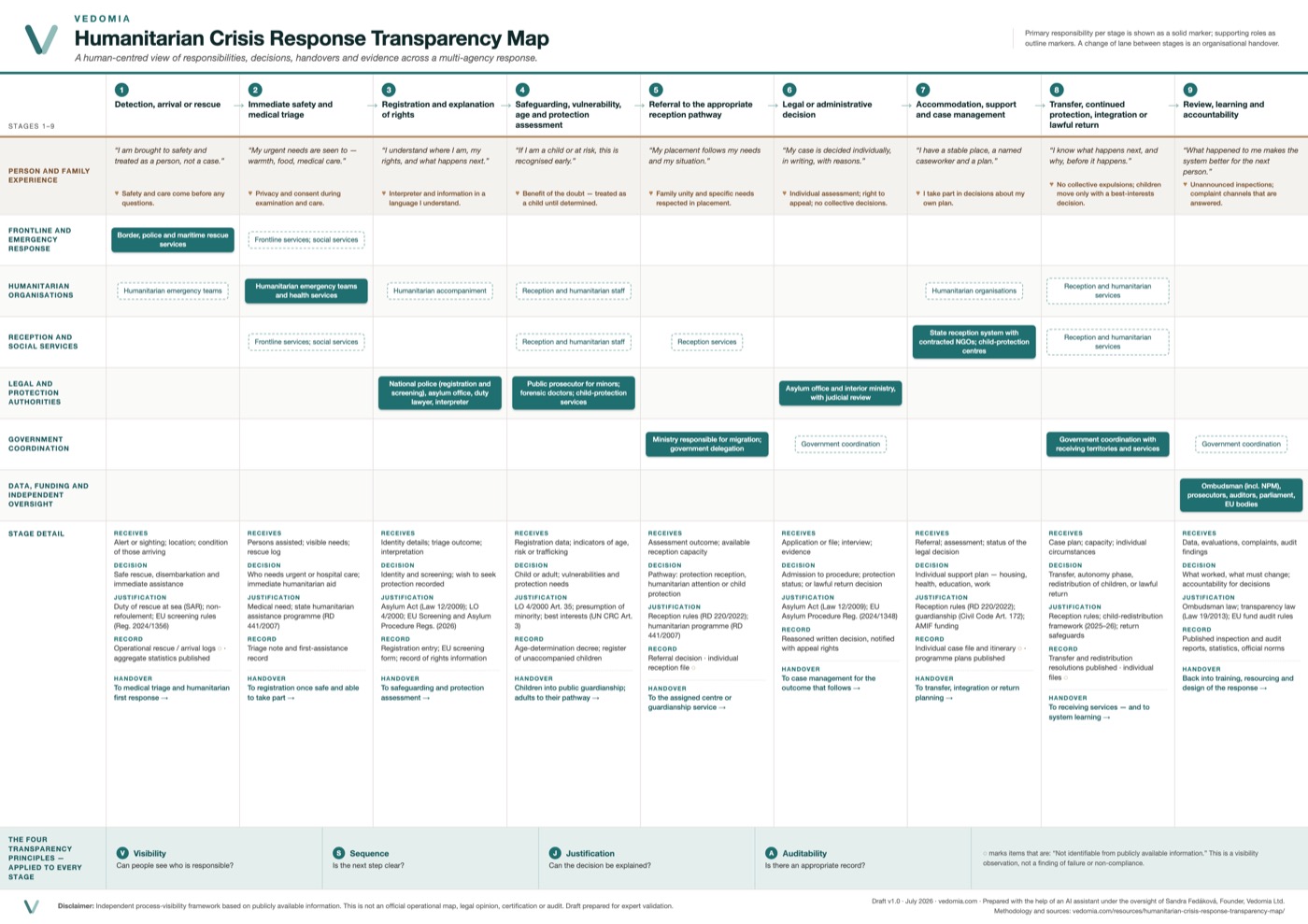
One A3 page. Nine stages · seven organisational lanes · decisions, justifications, records and dignity checkpoints for every stage.
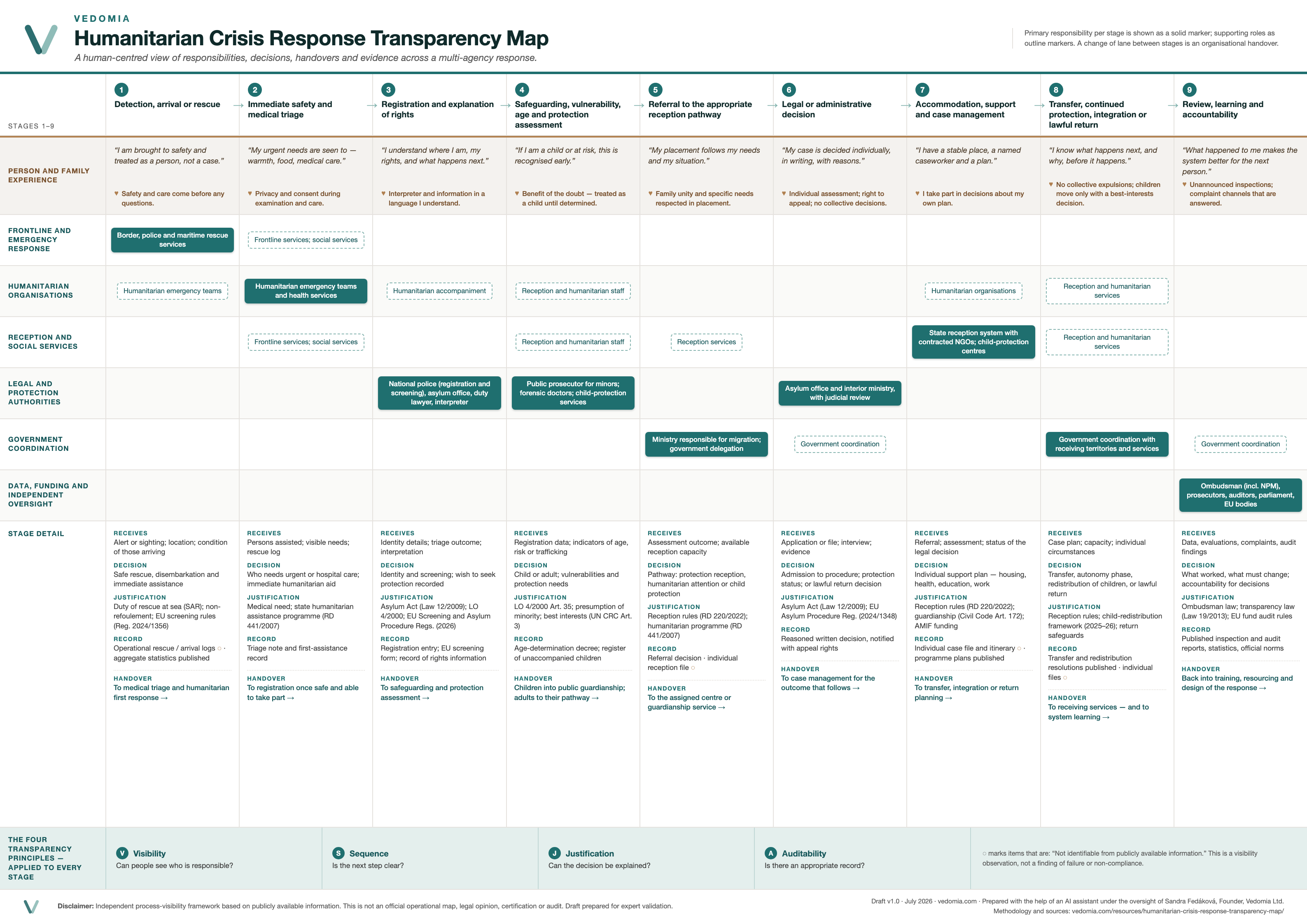
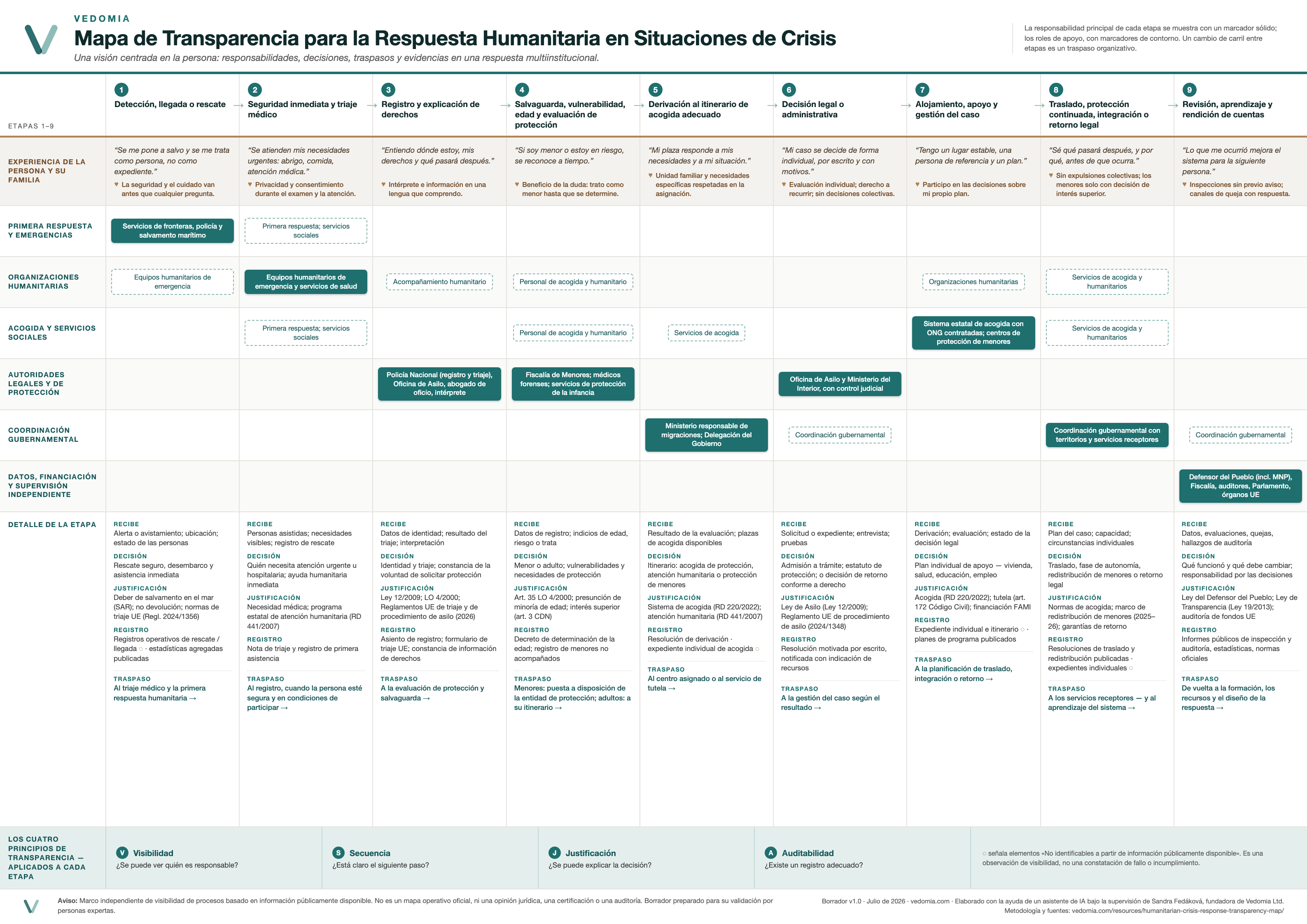
Free to download, print and share within your organisation. No sign-up.
What the map shows
In a humanitarian emergency, a person arriving moves through many hands: rescue services, medical triage, police registration, safeguarding assessments, reception services, legal decisions, case management, transfer or integration — and finally the oversight systems that are meant to learn from it all. Each organisation usually knows its own part well. What is hard to see is the whole sequence as one system: who is responsible at each stage, what decision is being made, on what basis, what record remains, and what the person on the other side actually experiences.
This map makes that sequence visible on one page. For each of the nine stages it shows the responsible role, the information received, the decision, its justification or legal basis, the record or evidence created, the handover to the next role — and a human-dignity checkpoint.
The four transparency principles
Can people see who is responsible?
Is the next step clear?
Can the decision be explained?
Is there an appropriate record?
Who can use it
- Humanitarian and reception organisations — to induct new staff and volunteers quickly, and to show funders and auditors how their part connects to the whole.
- Public authorities and coordinators — as a shared reference in multi-agency planning, briefings and after-action reviews.
- Funders and oversight bodies — as a starting frame for asking where responsibilities, decisions and records live.
- Trainers and educators — to explain how a rights-respecting humanitarian response is structured.
Methodology and sources
The map is an independent synthesis of publicly available information about how a multi-agency humanitarian reception response is structured in an EU member state, using Spain's published legal framework as the reference model — including the Asylum Act (Law 12/2009), the immigration law (LO 4/2000, incl. Art. 35 on age assessment), the reception system regulation (RD 220/2022), the humanitarian assistance programme (RD 441/2007), the child-protection framework (LO 1/1996; Civil Code Art. 172), the EU Screening and Asylum Procedure Regulations applicable since June 2026, EU AMIF funding rules, the transparency law (Law 19/2013) and the published mandates of independent oversight bodies. Where something cannot be confirmed from public sources, the map marks it “Not identifiable from publicly available information” (◌) — a visibility observation, not a finding of failure.
It is deliberately not named after any city or incident: the structure is reusable across humanitarian emergencies involving multiple public authorities, NGOs, reception services, legal systems and funding bodies.
Request a validation session
If you work in humanitarian response, reception or oversight and can pressure-test this framework against reality, I would genuinely value 20 minutes of your expertise. If your organisation wants its own verified process map, that is what Vedomia does — starting from a facilitated validation workshop.
Request a validation session See how a mapped session works