
Quality is more than compliance
Compliance is an essential part of quality in a funded organisation: funding agreements, eligibility rules, reporting deadlines.
But you can fill in every form, submit every report on time and pass every audit, and still have work that is slow, duplicated, frustrating for your team and confusing for the people you serve.
Compliance asks: did we follow the rules? Quality also asks: does our system reliably do what it is for? This guide is about the second question. Part 1 makes the work visible. Part 2 shows where it struggles. Part 3 improves it, and keeps it improving.
1. The anatomy of a funded organisation
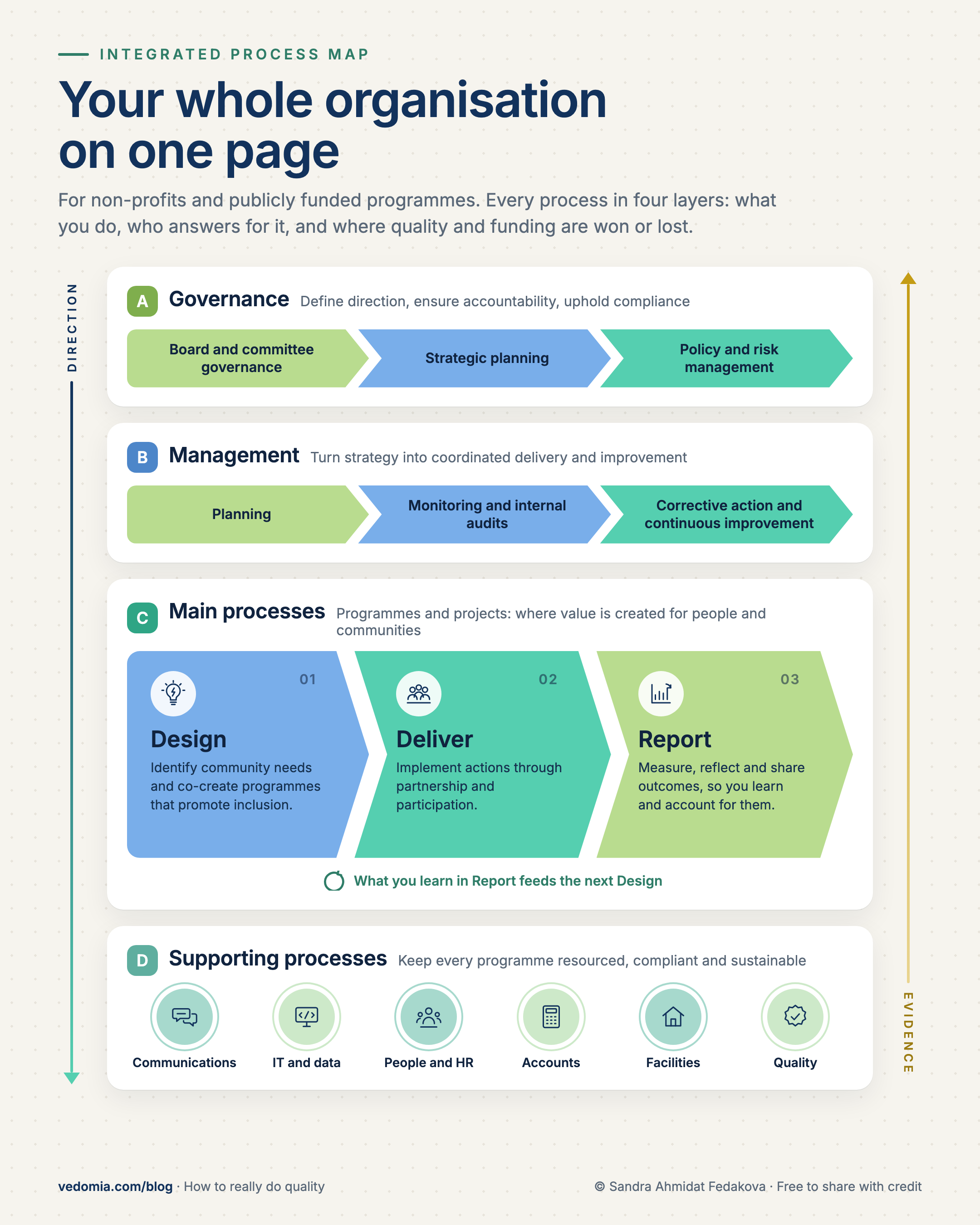
Local development companies, family resource centres, community organisations, social enterprises: if you live on funded programmes, it helps to see your organisation as four interconnected layers of process. Quality managers call it a process architecture. It is a practical way to see the work, not a required organisational structure. Draw it on one page. The map at the top of this article is one example.
Governance processes: direction and accountability
Where direction and accountability start. These decide where the organisation is going, and keep it answerable to its board, its funders and the public.
- Board and committee decisions, for example a finance and audit committee
- Strategy and policies
- Risk register and conflicts of interest
- Compliance with company law, charity law and your governance code
- Signing and overseeing funding agreements
- Oversight from outside: the funder or committee that contracts you, and their monitoring visits
Management processes: plan, check, improve
Where plans become coordinated actions. These turn the board's direction into a working year, and check whether it is working.
- Annual planning, with targets and indicators for each programme
- Monitoring performance during the year
- Evaluation and learning
- Internal audit and the management review of quality
Main processes: the programmes, where your mission happens
Where programmes create value for communities. Each funded programme belongs in this layer. It has its own funding agreement, target group, eligibility rules, indicators and reporting. Larger organisations group their programmes into pillars, for example:
- Work and opportunity: employment support, activation and work placement schemes, training and skills projects, enterprise support.
- Wellbeing and inclusion: social inclusion programmes, family and youth services, support for older people, migrant integration.
- Community-led development: rural development grants decided by a local committee, community group support, environment and energy projects.
A programme normally contains several interconnected processes. A useful way to group them is a simple lifecycle: design it, deliver it, report on it. You will map those in section 3.
Supporting processes: the cross-functional teams
Where tools, data and systems sustain everything. These serve every programme at once, and every programme depends on them. No single programme owns them, but each supporting process still has an owner in the organisation who answers for it.
- Accounts and finance
- IT and data protection
- HR, recruitment and staff wellbeing
- Facilities, premises and vehicles
- Front of house and reception
- Communications, including each funder's publicity rules
- Health and safety
- Quality assurance
A mistake in a supporting process shows up in every programme at once. One worker splits time across three programmes. If the timesheet is wrong, three claims are wrong.
2. Name your four customer groups
In quality management, it helps to think of anyone who receives an output and has expectations of it as a customer. A funded organisation has four groups, and they expect different things.
Your customer ecosystem is circular, not top-down.
Internal customers
The people inside your organisation, who receive each other's outputs.
Examples
- Employees and volunteers
- Board of directors or trustees
- Subcommittees and internal project teams
- Programme managers and coordinators
- Administration, finance, HR and IT teams
They expect: Clear roles and procedures. Systems that work. Supervision and development.
Collaborating and public stakeholders
Partners and wider society who amplify your work, or are affected by it indirectly.
Examples
- Local NGOs, development networks and businesses
- Schools, training providers and advocacy groups
- The general public and future beneficiaries
They expect: Coordinated delivery. Clear handovers. Safe, lawful data sharing.
Beneficiaries (external receiving customers)
Those who directly benefit from your services and supports.
Examples
- Individuals and families taking part in your programmes
- Community groups and social enterprises
- Local residents and neighbourhood networks
- Participants in training, employment or enterprise supports
They expect: Respectful, personal support. Easy access, online and in person. Clear information on how their data is used.
Investing and strategic customers
Organisations that fund, guide or partner in programme delivery.
Examples
- Government departments and state agencies
- Local authorities
- European funds
- Employers, colleges and strategic partners
They expect: Results for public money. Transparent, accurate data. Compliance with the funding rules and data protection law.
Write down the expectations for each group, in their words, not yours. Where to find their words: complaints and feedback, exit surveys, the funder's guidelines, committee minutes. They become the standards in section 5. Strictly, ISO 9001:2026 calls partners and the public "interested parties", not customers. You decide which of their needs and expectations are relevant to your quality system, and which ones it will address. Notice that the funder can play more than one role. It provides resources and sets requirements. It receives your information and results. Its exact role depends on the relationship.
3. Map your main programme: start with delivery
Now choose one programme: the one with the most money at risk, the next funder review, or the one where a mistake would hurt a person most.
A programme moves through three stages: design, deliver and report. Start with delivery. It is where people meet your service, and where most quality is won or lost.
Draw the work as it really happens, not as the procedure says it should. And draw it with the people who do it every day. They know where instructions are unclear, where steps are done twice, and where they improvise to get the work done. Quality is not something a quality department imposes. The aim is work that is more reliable and easier to do.
Below is an illustrative example. When a programme supports people, the work follows what social work calls the case management cycle.
Example: delivering a social inclusion programme
Read it top to bottom. Each lane is one role. On a phone, swipe sideways to see every lane.
- Step
- Decision
- Record (proof)
- Start or end
- Link to another process
- Critical step
- Optional step
Notice the review. Where a programme offers a review or an appeal, put it on the map: who handles it, how a person asks for it, and how they hear the outcome. Where there is no formal review, show the route for questions and complaints. If the route is not on the map, nobody owns it, and people do not know they can ask.
Design and report are processes too. Once delivery is mapped, draw them the same way. Design runs from a need to a signed funding agreement. Report runs from your records to the board, and back into next year's design.
Four rules that keep the map right
- A rectangle is a step. Someone does it, and its name starts with a verb. Arrows show the order.
- A diamond is a decision. It asks a question, most often yes or no, and every outcome gets its own arrow, including the "no". If the "no" is not on the map, the people who got a no will not be in your report.
- A document shape is a record: the proof a step leaves behind. An oval is where the process starts or ends. A circle links to another process.
- Three things are not steps. An output is not a step: draw it as a record, or as the next step. Waiting is not a step, but it must be visible: it is time between two steps, measured with two dates. Leaving is not a step: draw a withdrawal, a refusal or any other ending as an exit or a branch. It can happen anywhere.
4. One owner per step, and the handovers
Give each step one role: admin officer, key worker, programme manager, finance officer. Not "the team". The person you serve can have their own actions on the map, but every step your organisation takes is owned by one of your roles.
Draw the map in lanes, one lane per role, and start with only a few lanes. If many roles are involved, split the work into linked subprocesses rather than hiding who is responsible. Then count the arrows that cross from one lane to another. Each crossing is a handover: from admin officer to key worker, from programme to accounts, from your organisation to a partner. In my experience most failures happen at handovers, not inside a step.
At every handover, ask five questions:
- Does the person taking over have all the information they need?
- Is it clear who does the next step?
- Does the work stop while someone waits for an approval?
- Is the same information typed in twice?
- Could a mistake here turn up later in a report or a funding claim?
One wrong timesheet is the classic example. It is one small error in a supporting process, and it travels into three programme claims.
5. Give every step of the main process a quality standard
Now take the main process you mapped: Deliver. For every step, write one quality standard. Finish the sentence "It is working when…", so that anyone can check it. A standard can be about time, accuracy, completeness, access, safety or the person's experience.
A good standard has two sides. Right and on time: the rules, the conditions of the funding, the deadline. For the person: do they understand what is happening and why? Do they know where the support comes from? Are they treated with respect? Quality managers call the second side customer experience. In this sector it is called dignity.
The standards come from your four customer groups in section 2. The funder mostly writes the first side. The people you serve write the second.
Build quality into the step itself, not into a check afterwards. A clear standard prevents a mistake. An audit only finds it later.
| Step | Owner | It is working when… | Proof |
|---|---|---|---|
| Plan and do outreach in the community | Key worker | Right and on timea written outreach plan names the areas and groups, and every quarter it is checked against who found you (section 6).For the personthey hear about the programme where they already are, in words they use, and can tell it is for them. | Outreach plan and log |
| Receive the first contact | Admin officer | Right and on timea real answer within 3 working days.For the personthey are greeted by name and told, in plain words, what happens next and when. | Contact log with two dates |
| Register, explain data use and gather eligibility evidence | Admin officer | Right and on timeeligibility evidence collected as the programme requires, before any support starts. Personal data processed on the right lawful basis, with consent asked for only where it is that basis.For the personthey get clear privacy information and understand what data is kept and why, who funds the programme, and what that funder needs to see. | Registration record and privacy notice |
| Eligible?critical | Admin officer | Right and on timedecided against the current criteria, within 10 working days of a complete registration.For the personthey knew the criteria in advance, so the decision is no surprise. | Eligibility checklist, dated |
| Explain in writing, review route, signpost | Admin officer | Right and on timea letter within 5 working days: the reason, how to ask for a review, and where else to go.For the personthey hear it first in a conversation, not only in a letter, and leave with a next step. | Decision letter and note of the call |
| Review the decision, if the person asks | Programme manager | Right and on timereviewed by someone who was not part of the first decision, within 10 working days of the request.For the personthey can ask in their own words, by phone or in person, and are told the outcome and why. | Review note, dated |
| Assess needs | Key worker | Right and on timedone within 15 working days of acceptance.For the personthey tell their story once, and are asked about their strengths, not only their problems. | Assessment, confirmed by the person |
| Agree a personal plan | Key worker | Right and on timeat least one goal, agreed within 10 working days of the assessment.For the personthe goal is in their own words, and they keep a copy. | Personal plan |
| Deliver the support | Key worker | Right and on timeevery agreed action by its date, or the change recorded with a reason.For the personthey know who to call, and are told before anything changes. | Support record |
| Referral needed? | Key worker | Right and on timeevery referral made with the person's informed agreement, and their data shared only on a lawful basis.For the personthey understand why, and what the other service will and will not do. | Referral note, with the person's agreement |
| Confirm arrival within 15 dayscritical | Key worker | Right and on timearrival confirmed within 15 working days, or followed up the same week.For the personthey are introduced by name, not just handed a phone number. | Referral record |
| Goals met, ready to close? | Key worker | Right and on timeprogress reviewed at least every 3 months.For the personthey judge their own progress first. | Review note |
| Close the case | Key worker | Right and on timeevery closure has a recorded reason.For the personthe ending is agreed with them, and they know they can come back. | Exit record with reason |
| Follow up after closing (optional) | Key worker | Right and on timeif funded, contact 3 months after closing, with "not reached" recorded too.For the personthey are asked what helped and what did not. | Follow-up note |
Measure the human side too. Once a quarter, ask a few people, including some who were refused or who left, three questions: Did you understand what was happening? Did you know why? Were you treated with respect? Their answers are your proof.
All deadlines in this example are illustrative. Where a programme's rules or the law set a deadline, follow that one. Two standards apply to every step. Every safeguarding concern is passed on without delay, under your safeguarding procedures and any legal duty to report. If the concern is about a child, telling your designated liaison person does not replace a mandated person's own duty to report to Tusla. If someone is in immediate danger, call 112 or 999 straight away. Personal data is used lawfully, fairly and transparently, and only for the purposes you have named. You collect only what you need. You keep it accurate and safe, and no longer than you need it. The two red rows are the critical steps you will meet in section 7.
The skeleton is done
Take a breath. If you have done sections 1 to 5, the hardest part is behind you.
You can see your whole organisation on one page. You know who you serve and what they expect. You have mapped your main process, and every step has a standard you can check.
That is the skeleton of a quality system. Many organisations never get this far. What follows is lighter: count who found you, find the weak spots, keep the proof tidy, and show your work.
6. Count who found you
Every number so far is about people already in your files. This one looks outside the door. Of all the people in your area who could use the programme, how many found you?
It belongs to the first step on your map: "Plan and do outreach in the community".
About 3 in 10
of the people in our area who could use the programme found us in the last 12 months.
- Found us, we had room
- Found us, still waiting
- Not met yet
Invented round numbers. The 1,700 to 2,300 is an estimate from public census tables.
Where are the 7 in 10 we have not met yet?
- Found us
- Not met yet
What it says about quality
In this example, 3 in 4 people who got a decision were eligible. So the message mostly works: people understand who the programme is for.
But only about 3 in 10 of the people it is for found it, and in the rural district only about 1 in 7. That is a quality finding about the outreach step. It is not about the people who did not come. Maybe they did not hear about it, did not think it was for them, or found it too hard to reach. Some may have got help elsewhere. The 3 in 10 compares 600 eligible people with an estimate of 1,700 to 2,300. It is a starting point for questions about access, not a verified rate.
There is a second finding. Even at 3 in 10, more people found the programme than it had room for. So the answer is not simply more outreach. It is fairer outreach: to the districts with the lowest rate. And you show the funder how many people are waiting.
What the two numbers tell you about quality
A gap is normal
Eurofound, an EU agency based in Dublin, looked at estimates from 16 EU countries. In every one, there was at least one benefit that more than a third of entitled people did not get. The usual reasons: people did not know, it was too hard to get, or they felt ashamed. Eurofound sees the causes in four places: the rules of the scheme, the office that runs it, the person, and society. Your own front door is part of that "office". Eurofound (2015), Access to social benefits: Reducing non-take-up.
How to count it in one afternoon
- Mark your area. Open the CSO Census 2022 map at visual.cso.ie and list the electoral divisions you really serve.
- Turn your main eligibility rule into a census column. For long-term unemployment, the low count is "long-term unemployed". For the high count, add "looking for first regular job".
- Add up your divisions. Write the result as a range: "about 1,700 to 2,300", and the census year.
- Count from your own records. Take the last 12 months. Count the people from your area marked "Yes" at "Eligible?". Each person once. No names needed.
- Count the decisions too. Add the people from your area marked "No". Write it as "600 of 800". That is the second number: the right people.
- Draw ten figures. Under them, write how you counted. Count again every quarter, the same way.
Keep it honest
- Say "found us", not "only 30% know us". Getting in touch is not the same as knowing about you.
- Always a range and the census year. Never a precise percentage. The census counts one day, your records a whole year, so the true share is probably a little lower.
- No target and no bonus on this number. Otherwise the team starts looking for the people who are easiest to find.
- A grey figure is not a failure. We do not know their situation. Some may have got help elsewhere, or may not need it now.
- Say "went up after", never "went up because of".
7. Find the critical steps
Not every step needs the same attention. For each step, ask three questions. Score each one from 1 (low) to 3 (high).
- How badly would a mistake hurt the person, or the funding?
- How often could it happen?
- How likely is it that nobody would notice?
Multiply the three numbers. The highest scores are your critical steps. One rule beats the maths: if a mistake would badly hurt a person (a 3), the step is critical. Quality engineers call this a light FMEA.
| Step | What could go wrong | Score |
|---|---|---|
| Eligible? | "Not eligible" given wrongly | 3 × 2 × 3 = 18 |
| Confirm arrival | Referral made, person never arrives | 3 × 2 × 3 = 18 |
| Register and gather evidence | Evidence missing, funder rejects the participant | 2 × 3 × 2 = 12 |
| Programme claims (accounts) | A cost that does not qualify is claimed | 3 × 2 × 2 = 12 |
Notice two things. The worst risks hide where nobody would notice, because the person has already left. And one critical step usually sits in accounts, where a weak record becomes money lost. Choose three to five critical steps. In part 2, each one gets a check.
8. Keep the proof tidy
Every document in your system belongs on one of four levels. Each level answers to the one above it.
Give every map and procedure a version, a date and an approver who did not write it. Keep one master copy. Archive the old ones.
9. Test it on one real case
Take one real case. Follow it through the map with the person who did the work. You will find steps nobody drew. Fix the map until it shows what really happens.
A map of how things should work is a wish. A map of how they do work is a tool.
10. Make it visible
A quality system that lives in folders is invisible. Put it on one simple internal site, in SharePoint or Google Sites. Give every programme and every cross-functional team its own page, with its map, its standards and its documents.
Add one line at the bottom of every page: last reviewed, reviewed by, next review. That line tells everyone the page is alive.
Then look at the whole system through four quality principles. Each one is a different kind of transparency:
| Quality principle | What people can see |
|---|---|
| Process approach | How a request becomes a result, step by step |
| Customer focus | Who you serve and what they expect |
| Leadership | What was decided, by whom, and why |
| Improvement | What went wrong, what changed, and whether it worked |
11. Check your work in one hour
Sit down as a team of three or four. Open the map, the standards and one real file. Answer yes or no. Every "no" is your next task.
One-hour quality check
- Can we see all four layers on one page, including who funds and oversees us?
- Does every step start with a verb, and does every decision show its "no"?
- Does every step have one named role?
- Does every handover say how the other side confirms it?
- Does every step have a standard with who, what and by when?
- Does every standard name a record we can find today in a real file?
- Do we have 3 to 5 critical steps, and at least one in finance?
- Has the map been tested on one real case?
- Do we know how many of the people who could use us found us, and where the others live?
12. How to report on what you built
Your board or funder does not need the whole system. They need to see, honestly, how far you have got. Use counts, always "X of Y":
- Programmes mapped: X of Y
- Steps with one owner: X of Y
- Steps with a quality standard: X of Y
- Maps tested on a real case: X of Y
- Eligible people who found us: X of about Y to Z, with the census year
Add one sentence on what is still missing, and when it will be done. That sentence builds more trust than any percentage.
What to avoid
- Calling the system "compliant" or "validated" before it has run for a while.
- Percentages without the base. Say "4 of 5", not "80%".
- Reporting only what exists, and not what is missing.
In part 2 you put on the quality manager's hat. Each critical step gets a control plan: what you check, how often, who checks, and what you do when it fails.
How to really do quality · a guide in three parts
- Part 1. Build the system
- Part 2. Run it every week
- Part 3. Review it and improve
Do part 1 in our free process map
Every step in a Vedomia map asks for its owner, input, output, the record it leaves, what happens on a "no", and "It is working when…". Lanes are drawn for you. Free, no sign-up.