
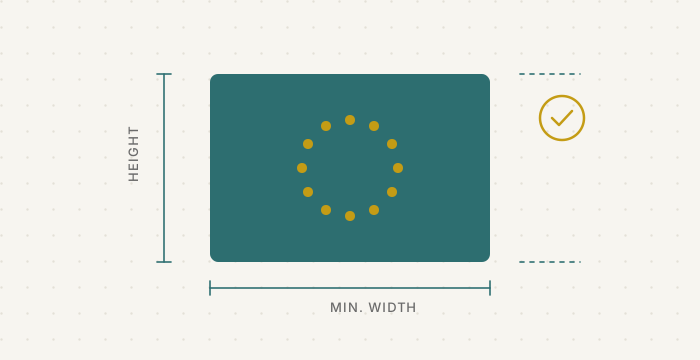
Most EU-funded organisations know they need to display the EU flag. What fewer realise is how specific the requirement is. Annex IX of Regulation (EU) 2021/1060 does not say “display the EU logo somewhere.” It specifies the exact wording, the minimum size, the placement relative to other logos, and where the statement must appear. Getting any of these details wrong can trigger the financial penalty under Article 50(3) — up to 3% of your EU support. Here is what you actually need to do.
The required statement — why “EU-funded” is not enough
The regulation requires two things to appear together: (1) the Union emblem — the circle of yellow stars on blue background — and (2) a written statement. The statement must be one of only two options:
- “Funded by the European Union” — for operations where 100% of support comes from EU funds
- “Co-funded by the European Union” — for operations where the beneficiary or member state also contributes
These phrases must be written in full. This is stated explicitly in Annex IX: the statement must be “written in full.”
The following do not satisfy the requirement: “EU-funded”, “With EU support”, “Supported by the EU”, “Funded by ERDF”, “Co-funded by ESF+”. None of these are acceptable substitutes. If your organisation uses any of these, you are technically non-compliant.
If you want to add the specific fund name (ERDF, ESF+, Cohesion Fund), you may — but only after the required statement. For example: “Co-funded by the European Union — European Social Fund Plus (ESF+)”. You can also refer to the complete EU transparency guide for a full breakdown of how fund identification works alongside the mandatory statement.
Placement rules
The emblem and statement must appear together — the statement directly next to the emblem, not on a separate part of the page. The emblem must be displayed at a size at least equal to any other logo or institutional emblem on the same material. If your organisation’s logo appears at 4cm, the EU emblem must be at least 4cm. If a funder’s logo is larger, the EU emblem must match or exceed it.
This rule prevents the EU emblem from being buried at the bottom of a page in small print while other logos feature prominently. The emblem is the single most important visual requirement — it signals to the public where the money came from.
Where the emblem and statement must appear
On all documents and publications relating to the operation — this includes:
- Project reports, annual reports, newsletters, brochures, leaflets, presentations, and any other written material about the funded work
- Your organisation’s website: a statement acknowledging EU financial support, with the emblem, and a short description of the operation including its aims, results and the amount of EU financial contribution. The EU Financial Transparency System provides additional context on how this information connects to public spending databases
- Social media: posts specifically about the funded project must carry the emblem and acknowledgment
- At events relating to the project: the emblem must be displayed prominently
- In press releases and media communications about the project
Note: you do not need to add the EU emblem to every internal document, email, or unrelated communication. The obligation applies to materials about the funded operation.
Physical display — plaques and posters
For larger projects, additional physical requirements apply:
- ERDF / Cohesion Fund operations where total cost exceeds €500,000: a durable plaque or billboard must be installed at the project site once physical implementation begins
- ESF+, JTF, EMFAF, AMIF, ISF, BMVI, Interreg operations where total cost exceeds €100,000: same requirement — durable plaque or billboard
- Operations below these thresholds: at minimum one A3 poster at a publicly visible location
“Durable” is significant — the plaque must last beyond the project, not just during implementation. A printed paper poster taped to a wall does not constitute a durable plaque for above-threshold operations.
The three most common mistakes
1. Using abbreviated wording (“EU-funded”, “supported by EU”) instead of the full required phrase.
2. Displaying the EU emblem without the written statement next to it, or placing the statement on a different part of the page.
3. Failing to document compliance — no photographs, no screenshots, no dated records — leaving no evidence when a compliance check arrives.
Why this level of specificity?
The EU’s visibility requirements exist for a reason: public accountability. When a citizen sees “Funded by the European Union” on a project, they can trace public money. Abbreviations and informal phrasing break that chain of accountability.
The regulation is specific because the EU has learned, from decades of implementation, that vague requirements produce inconsistent compliance. The 3% penalty exists to enforce minimum standards — not as a punishment for imperfect communication, but as a mechanism to ensure the basic public accountability chain holds.
“Transparency is not the act of displaying the right logo. It is the act of making information genuinely understandable. The emblem requirement is the beginning of this chain, not the end of it.”
Is your organisation’s EU visibility compliant?
Our free Transparency Audit covers 20 questions including EU compliance, governance, financial transparency and communications — with a scored report and tailored action plan.