
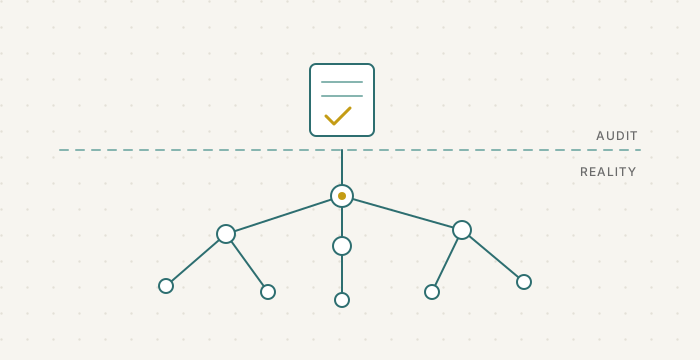
Every year, thousands of EU-funded organisations pass their visibility compliance checks. The EU emblem is on their materials. The correct wording appears next to it. A plaque is on the wall. They submit the required documentation and the check is passed. And then, sometimes months later, their beneficiaries begin to lose trust in them. Their funders start asking questions. Their staff cannot explain how decisions are made. Not because anything illegal happened. Not because of fraud. Simply because the organisation was compliant — and compliance, it turns out, is not the same as transparency.
What compliance actually covers
EU visibility requirements under CPR 2021/1060 Annex IX are minimum legal standards. They specify: which logo to display, what wording to use, what size the emblem must be, what physical signage to install, what to publish on your website. These requirements serve a legitimate purpose: they create a visible, traceable link between EU public money and the organisations and projects it funds. When a citizen sees "Funded by the European Union" on a building or a document, they can trace that money. The 3% financial penalty for non-compliance (Article 50(3)) exists because this public accountability chain matters. None of this is trivial. EU compliance is important, it is legally enforced, and it is the non-negotiable foundation of operating as an EU-funded organisation.
But here is what compliance does not require: it does not require your organisation to explain how governance decisions are made. It does not require you to describe how funds are allocated internally. It does not require you to have a process for beneficiaries to raise concerns. It does not require your board structure to be accessible to those you serve. It does not require you to be understandable.
The gap between compliance and transparency
Consider two organisations. Both receive ESF+ funding. Both display the correct EU emblem and wording on all materials. Both have the correct plaque at their project site. Both pass the managing authority's compliance check.
Organisation A: its annual report has perfect EU branding, but contains no explanation of how the governing board is selected, no description of how grant funds are allocated between programmes, and no information about how beneficiaries can raise a complaint.
Organisation B: its annual report has the same EU branding, AND a clear explanation of its governance structure, a breakdown of how funds flow through the organisation, and a named contact for beneficiary complaints.
Which organisation is more transparent? The compliance check cannot tell the difference. Both pass. But an experienced funder, a journalist, or a beneficiary who wants to understand what the organisation is actually doing — they can tell the difference immediately.
"Compliance tells you whether an organisation met the minimum standard set by its regulator. Transparency tells you whether the people the organisation serves can understand how it works."
Why this distinction has practical consequences
The gap between compliance and transparency is not abstract. It produces real consequences over time. Organisations that mistake compliance for transparency often encounter:
- Difficulty retaining donor trust beyond the first funding cycle — funders renew based on demonstrated impact and governance quality, not just compliance records.
- Challenges during mid-term evaluations, which increasingly assess organisational capacity and governance alongside financial compliance.
- Staff turnover driven by internal opacity — people who cannot understand how decisions are made, or who cannot trace accountability within the organisation, leave.
- Reputational vulnerability when something goes wrong — an organisation that has built no trust with beneficiaries or communities has no reserve to draw on when it faces a crisis.
The European Court of Auditors found in Special Report 11/2025 that EU fund managers rely mainly on self-declarations — they are not proactively checking governance quality. This means the gap between compliant and genuinely transparent organisations often goes undetected until a formal review, a funding renewal decision, or a crisis makes it visible.
What genuine transparency requires
Genuine organisational transparency is the degree to which an organisation's processes, decisions, and impacts are understandable to those it serves. This is not about disclosure for its own sake. Publishing more documents does not automatically produce transparency — a 200-page annual report that no one reads because it is written in bureaucratic language is not transparent.
Genuine transparency requires three things:
- Clarity — information is structured and written in a way that can be understood by its intended audience.
- Accessibility — people who need the information can find it without specialist knowledge or insider access.
- Accountability — there are real mechanisms for questions, challenges, and consequences — not just nominal ones.
In practice, this often means: governance documents that describe decision-making in plain language; a board structure that is explained rather than assumed; financial information that shows how money flows, not just totals; a complaints process that is actually known and usable by beneficiaries; internal processes that staff can describe consistently.
The Vedomia position
Our view is that internal transparency enables external transparency. If the processes inside an organisation are unclear — if staff cannot consistently explain how decisions are made, if accountability pathways are informal or invisible — then external reporting becomes a performance rather than a reflection of reality. An organisation cannot be genuinely transparent to the outside world if it is opaque to itself.
This is the core of how we approach transparency consulting. We are not primarily concerned with logos and plaques — those are your legal obligations and your starting point. We are concerned with whether your organisation is genuinely understandable: to your funders, your beneficiaries, your staff, and the communities you serve.
"The question is not whether you can pass the audit. The question is whether the people you serve can understand you."
Where to start
If you want to move from compliance to transparency, the first step is an honest assessment of the gap. Not what you declare, but what someone outside your organisation could actually understand about how you work. Some questions to begin with:
- If a new staff member joined today, could they understand how decisions in their area are made from the documents available to them?
- If a beneficiary wanted to know how the budget for their programme was determined, could they find out?
- If someone wanted to raise a concern about your organisation's work, do they know how?
- Could a journalist or funder visiting your website understand, in plain language, how your board is structured and how it makes decisions?
If the answer to any of these is "no" or "probably not", the gap between compliance and transparency is real — and worth addressing systematically. A Transparency Audit is the structured way to identify exactly where that gap sits and what it will take to close it.
Find your organisation's transparency gap
The Vedomia Transparency Audit assesses 20 areas across governance, financial transparency, communications and EU compliance — giving you a scored gap report and document templates for the areas that need attention.