
Slovenská verzia: prečítajte si článok po slovensky alebo prepnite jazyk vpravo hore (EN · SK).
In October, a citizen asked Vedomia to map something most people only meet on one of the worst days of their lives: how a criminal case moves through the Slovak justice system. Not a particular case, but the general route under the law, drawn so clearly that it also shows how several proceedings can run at the same time.
The starting point was a public diagram of the Czech criminal procedure, “Stadia trestního řízení” (Stages of Criminal Proceedings), published by the Czech public prosecution service [13]. The request was to draw the Slovak route in the same spirit, under Slovak law. I am publishing the results with the client's consent. Neither the text nor the maps describe the client or the client's case, and they contain no personal data.
I said yes because this is exactly the kind of system Vedomia exists for: public, consequential, and almost impossible to see from the outside.
Why ordinary people should know the route too
Criminal proceedings are the daily work of professionals: police officers, prosecutors, judges and lawyers. Yet the person with the most at stake is the person whose case it is, and that person often sees the route least clearly. I looked at what the law and research say about this. The answer is clear: understanding is not a luxury for the curious. It is part of what makes rights actually work.
What the law says
- Inform, and explain where needed. The police, the prosecutor and the court must always inform an accused person of their rights and give them full opportunity to use them. Where needed, the information on rights must be adequately explained to them (§ 34(5)) [1]. EU law requires suspects and accused persons to receive information about their rights in simple and accessible language [16]. The EU directive on victims of crime even has an article called “Right to understand and to be understood”. Communication with victims must be in simple and accessible language [17].
- You can also exercise your rights yourself. An accused person can exercise their rights personally or through defence counsel (§ 34(1)) [1]. A lawyer must protect and advance the client's rights and interests and follow the client's instructions, unless they conflict with the law (§ 18(1) of the Act on the Legal Profession) [18]. Whoever gives instructions needs to understand what they are deciding.
- You can consult your lawyer. An accused person has the right to choose defence counsel and to consult them, including during steps taken by the police, the prosecutor or the court. During their own questioning, however, they cannot consult counsel on how to answer a question that has been put to them (§ 34(1)) [1]. EU law guarantees access to a lawyer in a way that allows people to exercise their rights of defence practically and effectively, and also the right to meet their lawyer in private [19].
What the research says
- Most people with a legal problem do not seek advice. In a survey published in 2019, the World Justice Project polled more than 100,000 people in 101 countries. About half (49%) had experienced at least one legal problem in the previous two years. Only 29% of them sought any advice to help them understand or resolve it [20]. The survey focused on everyday civil and administrative problems, most often about consumer issues, housing, and money and debt, not on criminal proceedings.
- A fair, explained process is easier to accept. Research on procedural fairness shows that people are more willing to accept and abide by judges' decisions when those decisions seem to have been made fairly. The authors, two American judges, also write that people whose cases are before the court have a right to have key rulings explained in terms they can understand [21]. A study by the Center for Court Innovation lists understanding as one of five dimensions of procedural justice, alongside respect, neutrality, voice and helpfulness [22].
- People who do not understand are more vulnerable. In interviews with 102 people in two American cities with recent experience of criminal courts, jail or prison, many did not understand essential court processes, or understood them only superficially. They said this left them open to exploitation, for example when they accepted a plea deal without fully understanding what they were agreeing to [22].
- Not a given in Europe either. In 2019, the EU Agency for Fundamental Rights (FRA) summarised interviews with more than 250 accused persons and professionals in eight EU states. It found that information on rights is given in very different ways, sometimes only as a leaflet with no further explanation, and that authorities often do not check whether the person has understood it. Accused persons often receive only minimal or unclear information about what they are accused of. According to FRA, only an accused person's effective understanding of their rights makes it possible to exercise them [23]. The study did not include Slovakia.
- Complaints about lawyers most often concern communication. In England and Wales, complaints about the service lawyers provide are handled by the independent Legal Ombudsman. In 2025/26, the most frequently cited reason for a complaint was poor communication (24%), followed by delay (22%) and failure to advise (19%) [24]. This is a different jurisdiction and covers all areas of law, not only criminal cases. Still, it suggests where problems most often arise. A client who knows what to ask may catch them earlier.
- Most people in Slovakia do not rate the courts' independence as good. According to the European Commission's 2026 Rule of Law Report, only 35% of the general public and 38% of companies in Slovakia perceive the independence of courts and judges as fairly or very good [25]. Understanding will not replace reform. But understanding the route is one of the few things everyone can work on for themselves.
What you can do with the map, even with a lawyer
The map will not make you a lawyer. It can help you be a client who knows where they are, what to ask, and when something does not fit.
- Know where you are. Ask: Which step are we at? Who decides now? What can come next, and what would send the case back?
- Watch the deadlines together with your lawyer. A deadline usually runs from delivery or notification. For a judgment, notification means its announcement if you were present. So the appeal deadline can start running in the courtroom, not only once the written judgment arrives (§ 309(1)) [1]. If a decision is also notified to defence counsel, the deadline usually runs from the later notification (for example § 187(1), § 309(2), § 355(1)) [1]. When something arrives or a decision is announced, tell your lawyer the same day. Agree whether a remedy will be filed, who will file it and by when.
- Notice when something is missing. The Information DNA map shows which document each of ten key steps produces and who receives it. If you did not receive something, ask. As a rule, you can also inspect the file yourself (§ 69(1)) [1]. In pre-trial proceedings, the police or the prosecutor can refuse this for serious reasons (§ 69(2)).
- Come prepared. When you know what comes next, you can bring your lawyer the facts, documents and names of people who can confirm something, in good time. Defence counsel must in particular see to it that facts which clear the accused or reduce their guilt are properly established in time (§ 44(1)) [1]. Counsel may not know many of them without you.
- Understand what you agree to. Before you conclude an agreement on guilt and punishment, declare at the main trial that you are guilty, withdraw an objection to a penal order or waive a remedy, ask: What do I gain? What do I give up? What can no longer be changed afterwards? For example, a declaration of guilt accepted by the court cannot be revoked (§ 257(5)) [1].
- If you are a victim, do not miss the compensation deadline. If you want the criminal court to decide on compensation, you must make your claim no later than the end of the investigation or summary investigation (§ 46(3)) [1]. Otherwise you can usually claim compensation only in separate civil proceedings.
- Know that you have a choice. You can choose another defence counsel instead of the one you chose before. You can also choose your own counsel instead of one appointed by a judge (§ 39(5), § 40(5)) [1]. However, changing counsel is not a reason to reschedule a procedural step that has already been set (§ 36(4)) [1], so raise doubts early. You can complain about a lawyer to the Slovak Bar Association. The lawyer must respond promptly when the Bar asks (§ 28(4) of the Act on the Legal Profession) [18].
Why criminal procedure is hard to map
Criminal procedure is written as law, not as a route. Turning one into the other took far longer than drawing the boxes. Seven things made it hard.
- The decisions are scattered. The Code of Criminal Procedure (Act No. 301/2005 Coll.) runs to hundreds of sections [1]. The prosecutor's options at the end of an investigation alone are spread across sections 214 to 234.
- Many decisions are not just “yes or no”. The law often lets an authority choose between several options. Where it does, the map shows the question and lists every option the law names. It does not invent a single path.
- The route does not only go forward. Some decisions send the case a step back, for example from the appeal court to the first-instance court. From there, the case can reach the same decision again. So the map also has to show the loops, and what holds them in check.
- The same thing changes its name. Before a prosecution starts, a case that belongs to another authority is handed over (odovzdaná, § 197). Once a prosecution is running, it is referred (postúpená, § 214). A person becomes an accused person (obvinený) when charged. They become a defendant (obžalovaný) only once the court orders a main trial (§ 10(12)), and may never become one.
- The law keeps moving. Amendment No. 40/2024 Coll. changed several steps [2]. I mapped the version in force from 18 August 2026. As at 21 October 2026, this version was last amended by Act No. 168/2026 Coll. Some of that act's changes, and most of the new Act No. 167/2026 Coll. on international judicial cooperation in criminal matters, take effect only on 1 January 2028 [3].
- Free copies of the law are not always current. The deadline for a complaint against a resolution is, as a rule, three working days (§ 187(1)) [9]. Some freely available copies of the law still say three days. One word decides whether a complaint is filed in time.
- Several proceedings can run at once. The same person can face more than one case, including in different EU states. Cases can be joined, separated or suspended. A new prosecution can be barred if the same act has already been finally decided. A map of one case has to show where it can connect to another.
And one more, which is the reason Vedomia exists: accurate is not the same as understandable. A lawyer needs every section. A person who has just received a letter from the police needs to know what happens next, and how many days they have.
Where I looked, and how I worked
I worked the way I learned to work as a quality engineer: define the scope, use primary sources only, record every decision, and check the result separately from the work that produced it.
- Scope. Agreed with the client: the general route of a criminal case under the law, including the points where one case can connect to another, with no details of any particular case.
- Primary sources only. Every step is tied to a section of the law, read on Slov-Lex, the official legal portal of the Slovak Ministry of Justice: the Code of Criminal Procedure, the Criminal Code, the Constitution and the amending acts [1–5]. EU law came from EUR-Lex [6, 7].
- Checking the current wording. The tools I used could not always load the full consolidated text of the Code. Where that happened, I confirmed the wording in force through recent decisions of the Constitutional Court, the Supreme Court and the prosecution service (2025–2026) that quote it word for word, and through the text of the amending act itself [2, 8–12]. In the final check, I compared every cited section directly with the full text on Slov-Lex [1].
- A standard notation. The detailed flowchart uses the symbols of ISO 5807 [14]. Each lane is one actor. Each yellow diamond is a decision with labelled answers. Each step shows its section of the law. A separate page shows the loops where a case goes back.
- Independent checks. After the maps were drawn, every sentence and every section number was checked against the sources in separate reviews that had not seen how the first draft was written. They read the text as a lawyer, as a judge and as a language editor would.
- Readable for everyone. The visuals follow the British Dyslexia Association's Dyslexia Style Guide [15]: a clear sans-serif typeface, larger text, a cream rather than white background, no italics or underlining, and short sentences. Icons always come with words, and colour is never the only signal.
What the map shows
The full result is a nine-page flowchart, a one-page infographic, a seven-step poster and a short video, each in English and in Slovak (downloads below). These are the core findings.
1. Five points where decisions are made
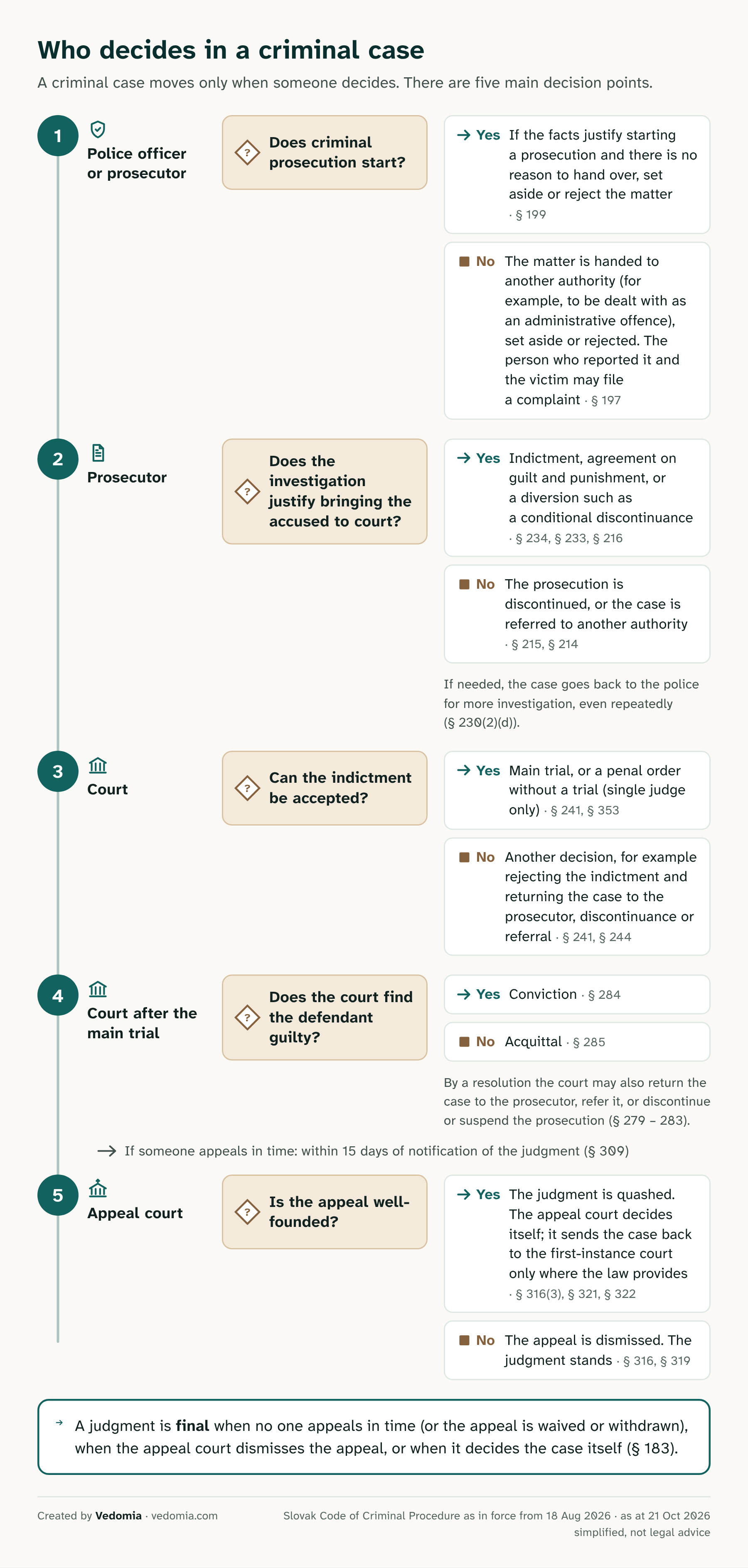
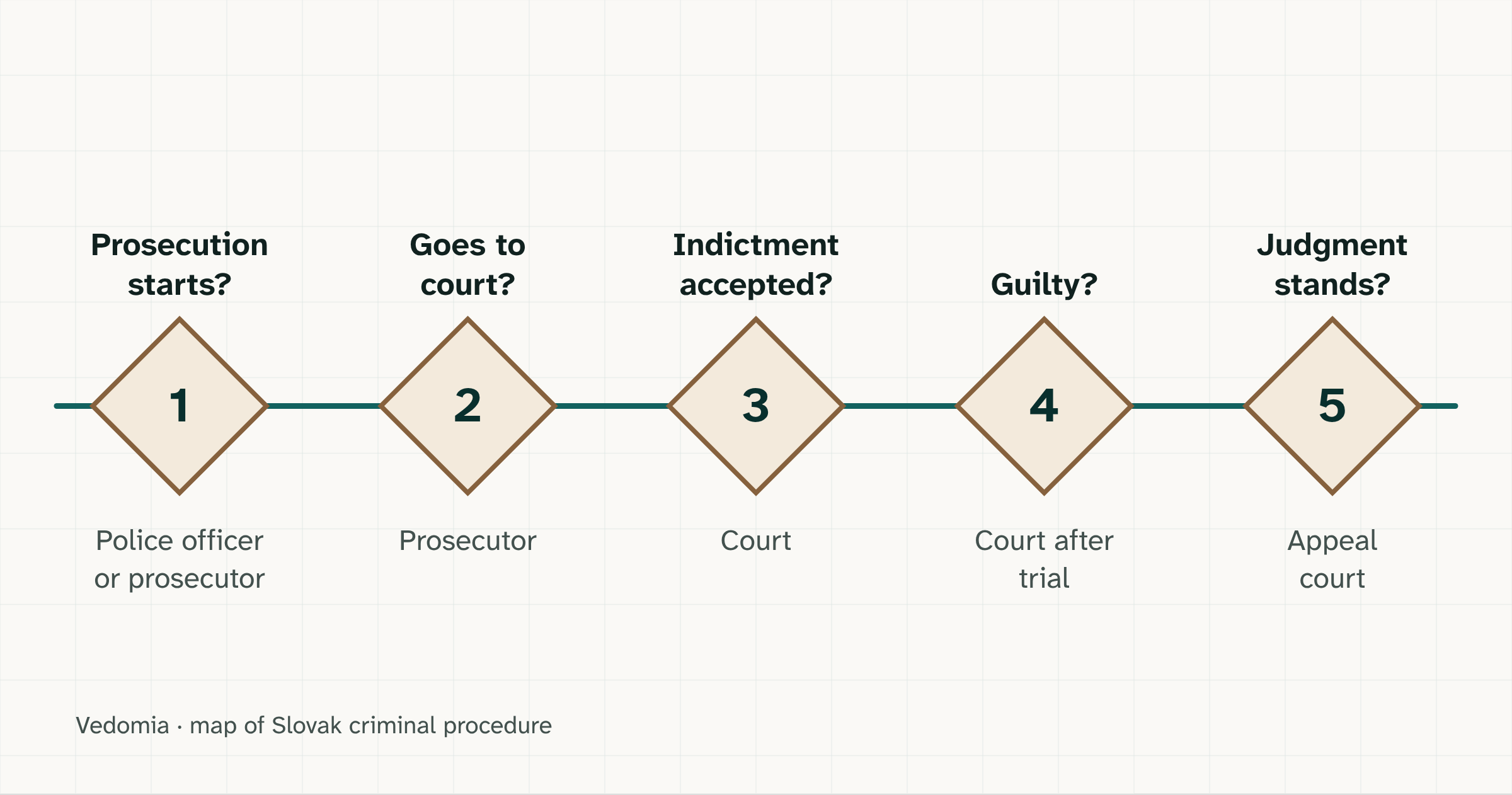
A criminal case does not move by itself. It moves because someone decides. There are five main decision points:
- A police officer or prosecutor assesses the report of a crime or other information and decides whether the facts justify starting a criminal prosecution. If there is no reason to hand the matter over, set it aside or reject it, the prosecution starts by a resolution (§ 199). Otherwise, by a resolution, they hand the matter over to another authority (for example, to be dealt with as an administrative offence), set it aside or reject it (§ 197(1)). The person who reported it and the victim may file a complaint against that resolution (§ 197(3)).
- The prosecutor, at the end of the investigation, files an indictment (§ 234) or a motion to approve an agreement on guilt and punishment (§ 232, § 233). They may also choose a diversion, such as a conditional discontinuance (§ 216) or a settlement (§ 220). They may discontinue (§ 215) or suspend (§ 228) the prosecution, or refer the case to another authority (§ 214). They may also send the case back to the police for further investigation (§ 230(2)(d)).
- The court, once the indictment is filed, orders a main trial. Instead, a single judge may issue a penal order without a main trial (§ 353). The court may also decide otherwise, for example by rejecting the indictment and returning the case to the prosecutor, which sends it back to pre-trial proceedings (§ 241, § 244). If the accused objects to defects in the pre-trial proceedings within 5 working days of receiving the indictment, the court also decides whether to accept the indictment (§ 241(1)(l), § 244(1)(k)).
- The court, after the main trial, finds the defendant guilty or acquits them by a judgment (§ 284, § 285). By a resolution, it may also return the case to the prosecutor for further investigation, refer it, or discontinue (also conditionally) or suspend the prosecution (§ 279 – 283). If the defendant declares at the main trial that they are guilty and the court accepts this, no evidence is taken on the admitted act, and the defendant can no longer appeal the finding of guilt (§ 257(5) and (8), § 307(1)(b)).
- The appeal court dismisses the appeal (§ 316, § 319) or quashes the judgment (§ 321). It then either decides the case itself (§ 322(3)) or sends it back to the first-instance court. If another act has come to light and the prosecutor asks for it, it can also return the case to the prosecutor (§ 323). It sends the case back to the first-instance court if it finds a serious procedural defect, for example that the defendant had no defence counsel although representation was mandatory (§ 316(3)). Otherwise it sends it back only if completing the proceedings itself would be unduly difficult or could lead to different findings of fact (§ 322(1)).
Alongside all of this, the pre-trial judge decides on custody (§ 72) and on orders such as a house search (§ 100). Since 2024, the pre-trial judge has also been deciding certain matters concerning an accused person who cooperates with the law enforcement authorities (§ 215(3), § 218).
2. Where a case can go back, even repeatedly
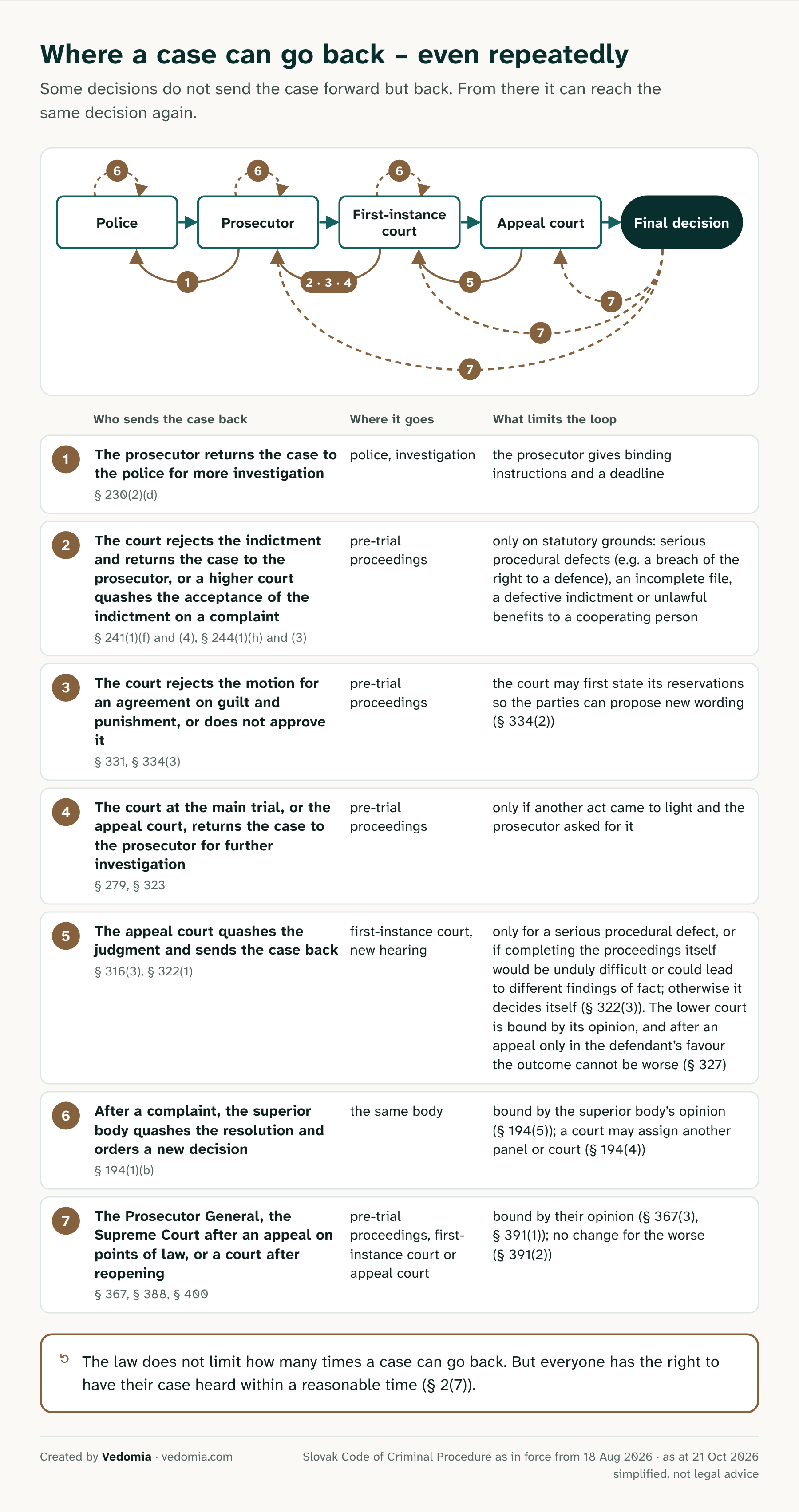
The process is not a straight line. Some decisions send the case back instead of forward, and from there it can reach the same decision again. The map shows the seven main loops:
- The prosecutor returns the case to the police. For further investigation, with instructions and a deadline (§ 230(2)(d)).
- The court rejects the indictment. If it finds serious procedural defects, such as a breach of the right to a defence, or an incomplete file, a defective indictment or unlawful benefits given to a cooperating person, it rejects the indictment and returns the case to the prosecutor (§ 241(1)(f), § 244(1)(h)). The case also goes back to pre-trial proceedings if a higher court, on a complaint, quashes the decision to accept the indictment (§ 241(4), § 244(3)). The prosecutor can file a new indictment, and the court reviews it again.
- The court rejects or does not approve an agreement on guilt and punishment. The case goes back to pre-trial proceedings (§ 331, § 334(3)). Before that, the court can state its reservations, and the parties can propose new wording (§ 334(2)).
- The court at the main trial returns the case to the prosecutor. Only if another act by the defendant comes to light and the prosecutor asks for the return (§ 279). The appeal court can do the same under the same conditions (§ 323).
- The appeal court quashes the judgment and sends the case back. It does so for a serious procedural defect, or if completing the proceedings itself would be unduly difficult or could lead to different findings of fact (§ 316(3), § 322(1)). The first-instance court hears the case again, and its new judgment can again be appealed. If the defendant was acquitted, the appeal court cannot find them guilty itself (§ 322(4)(a)). If it considers the acquittal wrong, it can only quash the judgment and send the case back.
- The superior body upholds a complaint. It quashes the resolution and orders the case to be dealt with and decided again (§ 194(1)(b)). This is how, for example, a decision to set a matter aside can be overturned and the matter decided again.
- Extraordinary remedies. The Prosecutor General (§ 366, § 367), the Supreme Court after an appeal on points of law (§ 388), or a court after allowing a reopening of the proceedings (§ 400) can quash a decision and send the case back for new proceedings.
The law does not limit how many times a case can go back. But it has brakes:
- Bound by the legal opinion. Whoever gets the case back must follow the legal opinion of whoever sent it back (§ 194(5), § 327(1), § 367(3), § 391(1)).
- No change for the worse. If a judgment was quashed only on an appeal filed in the defendant's favour, the new decision cannot be worse for them (§ 327(2)). The same applies to an appeal on points of law (§ 391(2)).
- The appeal court sends a case back only where the law provides. Otherwise it decides itself (§ 316(3), § 322(1) and (3)).
- Another judge or another court. A higher court can order the case to be heard again by another panel or another court (§ 194(4), § 325, § 388(2)).
- A reasonable time. Everyone has the right to have their criminal case heard within a reasonable time (§ 2(7)).
A case also goes back to pre-trial proceedings when the prosecutor withdraws the indictment before the main trial begins (§ 239(1)), or when the court, on the prosecutor's proposal, returns the case to the prosecutor so that an agreement on guilt and punishment can be concluded (§ 244(1)(g), § 255(3)).
Suspending a prosecution (§ 228) is not a loop. The case stands still. Once the reason for the suspension ends, the prosecutor or police officer decides to continue the prosecution (§ 228(5)).
3. How a person's status changes
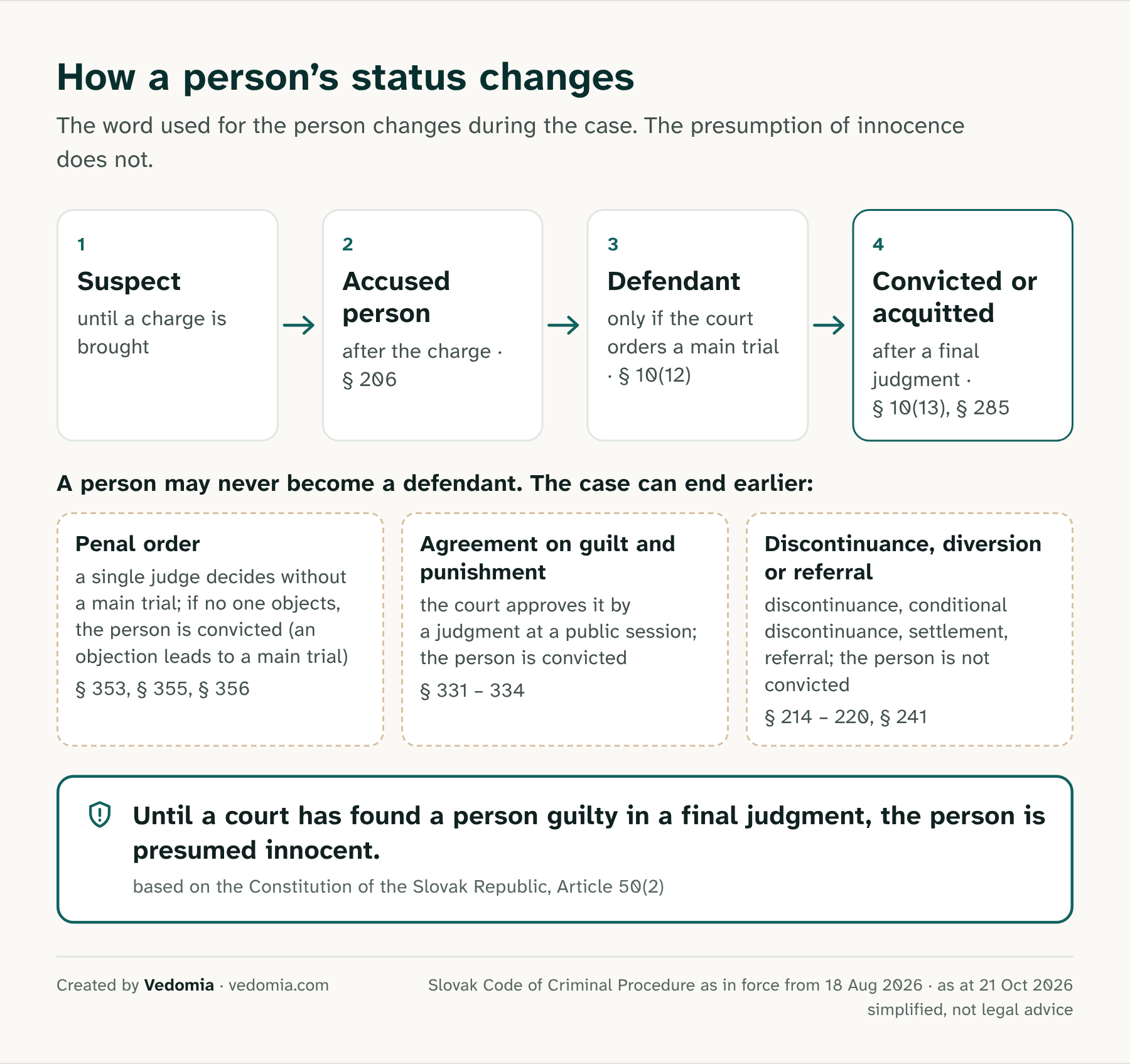
A suspect becomes an accused person when charged (§ 206). They become a defendant only when the court orders a main trial (§ 10(12)). They are convicted only once a judgment finding them guilty has become final (§ 10(13)); a penal order has the same effect (§ 353(8)). A final judgment of acquittal means they are acquitted.
A person may never become a defendant at all. The case can end earlier: with a penal order issued without a main trial, an agreement on guilt and punishment approved before any main trial, a discontinuance of the prosecution, a diversion or a referral of the case.
4. The deadlines are short, and they are counted differently
- Complaint against a resolution, where the law allows one: as a rule 3 working days from notification; if the resolution is also notified to defence counsel, from the later notification (§ 187(1)) [9]. Against some custody decisions, a complaint must be made immediately after the decision is announced (§ 83(2)).
- Objection to a penal order: 8 days from delivery; if it is also delivered to defence counsel, from the later delivery (§ 355(1)).
- Appeal against a judgment: 15 days from notification – that is, from the announcement if the person was present, otherwise from delivery; if the judgment is also notified to defence counsel, from the latest notification (§ 309).
- A victim who wants the court in the criminal proceedings to decide on compensation must make the claim no later than the end of the investigation or summary investigation, stating the grounds and the amount (§ 46(3)).
The complaint deadline counts working days; the objection and appeal deadlines count calendar days. The day of the event that starts a deadline is not counted. If the last day falls on a public holiday or a non-working day, the deadline ends on the next working day. A deadline is also met if the filing, addressed to the authority where it must be filed, is handed in at the post office on the last day (§ 63(3), (5) and (6)).
These are not all the deadlines, and the law has exceptions. For example, the accused can object to defects in the pre-trial proceedings within 5 working days of receiving the indictment (§ 241(1)(l)). Every judgment, resolution and penal order must state whether and how it can be challenged (§ 163, § 176, § 354). If you are not sure, speak to a lawyer straight away.
5. Information DNA: who learns what, and when
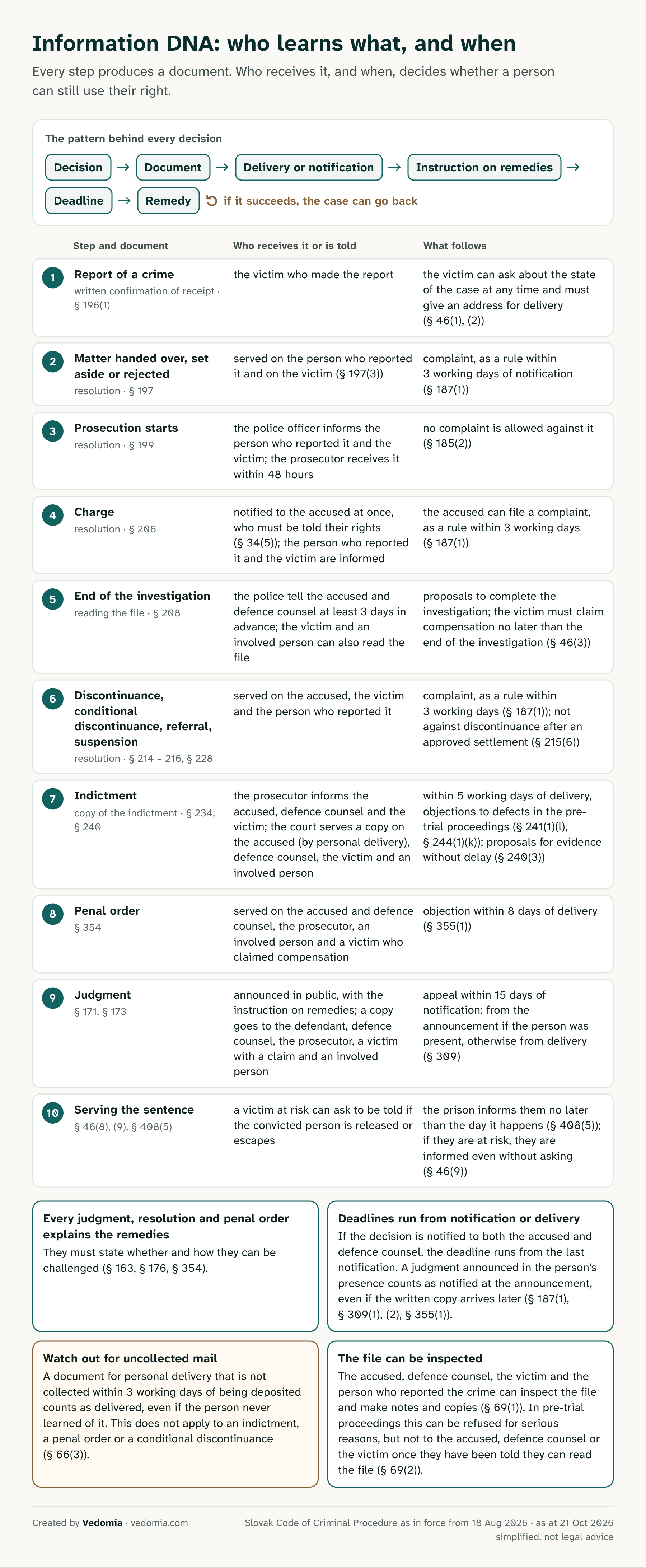
The same pattern repeats throughout the proceedings: someone decides, a document is produced, it is delivered or notified, it explains the remedies, a deadline starts to run and a remedy can be used. If the remedy succeeds, the case can go back. A person who does not receive the document, or does not understand it, can lose a right the law gives them.
- The accused is told about the charge at once and must be informed of their rights, including what a confession means (§ 206(1), § 34(5)). Before the investigation ends, the police tell them at least 3 days in advance that they can read the file and propose further investigation (§ 208(1)).
- The victim and the person who reported the crime receive the resolution if the matter is handed over, set aside or rejected, and the police inform them when a prosecution starts and when a charge is brought (§ 197(3), § 199(1), § 206(1)). The victim can ask about the state of the case at any time (§ 46(1)). A victim at risk can ask to be told if the accused or convicted person is released or escapes (§ 46(8)).
- No complaint is allowed against the resolution starting a prosecution (§ 185(2)). A complaint against the charge is allowed.
- Uncollected mail can mean a missed deadline. A document for personal delivery that is not collected within 3 working days of being deposited counts as delivered, even if the person never learned of it. This does not apply to an indictment, a penal order or a conditional discontinuance (§ 66(3)). That is why it matters to give the right address and report any change at once (§ 34(7), § 46(2)).
- The file can be inspected. The accused, defence counsel, the victim and the person who reported the crime can inspect the file and make notes and copies (§ 69(1)). In pre-trial proceedings the police or prosecutor can refuse this for serious reasons, but not to the accused, defence counsel or the victim once they have been told they can read the file (§ 69(2)).
For Vedomia, this is the core of the whole map: a system is transparent when the person concerned learns what they need to know, in time and in words they understand.
6. A step that changed in 2024
Amendment No. 40/2024 Coll. changed what happens after an objection to a penal order [2]. Today, when the accused, the prosecutor or another entitled person files an objection in time, the single judge first decides whether to accept the indictment and orders a main trial (§ 355(3), § 241(1)(j)). The prosecutor and the accused can file a complaint against the acceptance of the indictment. If a higher court quashes the acceptance, the penal order is also cancelled and the case goes back to pre-trial proceedings (§ 241(4), § 355(7)). Otherwise the penal order is, as a rule, cancelled only when the prosecutor presents the indictment at the main trial. Until then, the objection can be withdrawn (§ 355(8) and (10)). A victim's objection to the compensation ruling cancels only that ruling (§ 355(2)).
7. When several proceedings run at once
The map marks the points where one case can connect to another. All offences of the same accused person, and related offences of several accused persons, can be dealt with in joint proceedings (§ 18 – 20). A case can be separated from them for separate proceedings. Conversely, separately indicted cases can be joined (§ 21). A prosecution can be suspended (§ 228).
A person cannot be prosecuted again for the same act if the earlier prosecution ended in a final judgment, a final discontinuance, a conditional discontinuance after which the person successfully completed the probation period, or an approved settlement with a discontinuance, and that decision has not been quashed (§ 9(1)(e)). Under the conditions set by EU law, this also applies between EU states (Article 50 of the EU Charter of Fundamental Rights, Article 54 of the Convention implementing the Schengen Agreement) [6, 7].
Where the court convicts an offender of several offences, it imposes one aggregate sentence. If the offender committed an offence before a first-instance court announced a conviction for another offence, the court imposes a cumulative sentence (§ 41 and 42 of the Criminal Code) [4].
What the checks caught
The checks found errors in my drafts. I corrected all of them. Before the first publication there were four:
- the complaint deadline: “3 days” corrected to “3 working days” (§ 187(1));
- the objection to a penal order: corrected to the procedure in force since 2024 (§ 355(3));
- the first decision: a case there is handed over (odovzdaná, § 197), not referred (postúpená, § 214);
- an extraordinary appeal on points of law (dovolanie): added that the Minister of Justice can also file one, on a petition (§ 369(1)) [10].
After publication, I had the whole Slovak text and all the attachments read again from the point of view of a lawyer, a judge and a language editor. I checked every finding against the wording of the law. I corrected or added:
- the deadline for an appeal on points of law in the detailed flowchart: 3 years from delivery, in favour of or against the accused, not 6 months (§ 370(1));
- who reviews the indictment: the presiding judge for a crime (zločin) carrying a minimum sentence of 12 years or more, otherwise a single judge (§ 241(1), § 243(1));
- the start of a prosecution: described in the words of the current § 199, adding that a matter can also be rejected (§ 197(1)(d));
- the right of the person who reported the matter and of the victim to complain if it is handed over, set aside or rejected (§ 197(3));
- exceptions to deadlines: a complaint immediately after announcement for some custody decisions (§ 83(2)), and the summary investigation for compensation claims (§ 46(3));
- when a penal order is cancelled after an objection: not always only when the indictment is presented (§ 355(7), (8) and (10));
- when the appeal court sends a case back: also for a serious procedural defect (§ 316(3)), or directly to the prosecutor (§ 323);
- a guilty plea at the main trial: once the court accepts it, the plea cannot be withdrawn and the defendant cannot appeal the finding of guilt (§ 257(5));
- the rule that no one can be prosecuted twice, in the infographic: it applies only if the earlier decision has not been quashed (§ 9(1)(e));
- the loops where a case goes back, and the fact that a person may never become a defendant.
I am publishing these lists on purpose. A map that claims to contain no errors is harder to trust than one that shows how errors are found and fixed.
What to take away from the map
- Rights depend on deadlines. Three working days, eight days, fifteen days. A person who does not know the route often does not know that a clock is running.
- Knowing who decides tells you who to turn to. The police, the prosecutor, the pre-trial judge and the court each decide different things at different moments.
- There is no right without information. A deadline starts to run on delivery. A person who does not know that something has arrived can lose the chance to defend themselves.
- The route can go back. If you know that a decision can send the case back, you will not be surprised when the proceedings take longer, and you will know what to ask.
- The words carry weight. An accused person is not a convicted person, and not every accused person becomes a defendant. Understanding the labels protects the presumption of innocence in everyday conversation, not only in court.
- Understanding is not the same as trust. At Vedomia we call trust without understanding blind trust. Public institutions work better for everyone when people can see the route a case takes, not only the outcome in a headline.
- Explaining costs time. Organisations that support victims, witnesses, families or people in difficulty rebuild the same explanation again and again. A shared, checked map does it once, for everyone.
What this article is, and what it is not
- It is a simplified explanation for information and education. It is not legal advice, and it does not replace the wording of the law or advice from a lawyer. If you are involved in a criminal case, speak to a lawyer.
- Vedomia does not provide legal services and does not assess individual criminal cases.
- It describes the Slovak Code of Criminal Procedure as in force from 18 August 2026, checked as at 21 October 2026. The law changes; always check the current wording.
- It does not describe any real case or person. The client agreed to the publication.
- The Slovak maps were drawn from scratch, inspired by the public diagram of the Czech prosecution service [13] and adapted to Slovak law.
- If you find an error, write to contact@vedomia.com. I will check it against the source, correct it, and record the change and its date on this page.
- © 2026 Vedomia. The maps, the documents and the video may be shared unchanged, with Vedomia credited as the source.
Downloads
All files are free to use and share, unchanged and with the source credited. The English files are translations: where the wording differs, the Slovak versions and the text of the law prevail.
In English
- Flowchart: criminal proceedings in Slovakia · 9 pages, A4 landscape · PDFThe detailed map: every decision as a diamond with Yes and No exits, a lane for each actor, the section of the Code at each step, and a separate page on the loops.
- Poster: criminal cases step by step · A4 · PDFSeven steps on one page, for a noticeboard, a waiting room or a first conversation.
- Infographic: how criminal proceedings work · A4 · PDFThe whole route with the five decision points (marked G1 to G5 on the infographic), the person’s status, key deadlines and what happens when several proceedings run at once.
- Video: how criminal proceedings work · 4 min 14 s · MP4On-screen captions and original background music, no voice-over.
In Slovak (original)
- Vývojový diagram: trestné konanie v SR · flowchart · 9 pages, A4 landscape · PDF
- Plagát: trestné konanie krok za krokom · poster · A4 · PDF
- Infografika: ako prebieha trestné konanie · infographic · A4 · PDF
- Video: ako funguje trestné konanie · video · 4 min 14 s · MP4
Sources
- Act No. 301/2005 Coll., Code of Criminal Procedure, version in force from 18 Aug 2026 to 31 Dec 2027. Slov-Lex, Ministry of Justice of the Slovak Republic — static.slov-lex.sk
- Act No. 40/2024 Coll. of 8 February 2024 amending the Criminal Code and certain other acts (as promulgated). Slov-Lex — static.slov-lex.sk
- Act No. 168/2026 Coll. of 4 June 2026 amending certain acts in connection with the Act on International Judicial Cooperation in Criminal Matters; Act No. 167/2026 Coll. of 4 June 2026 on International Judicial Cooperation in Criminal Matters. Slov-Lex — static.slov-lex.sk, static.slov-lex.sk (167/2026)
- Act No. 300/2005 Coll., Criminal Code, version in force from 18 Aug 2026. Slov-Lex — static.slov-lex.sk
- Constitution of the Slovak Republic No. 460/1992 Coll., version in force from 1 Nov 2025. Slov-Lex — static.slov-lex.sk
- Charter of Fundamental Rights of the European Union (2016/C 202/02), OJ C 202, 7.6.2016, p. 389. EUR-Lex — eur-lex.europa.eu
- Convention implementing the Schengen Agreement of 14 June 1985, OJ L 239, 22.9.2000, p. 19. EUR-Lex — eur-lex.europa.eu
- Constitutional Court of the Slovak Republic, decision II. ÚS 394/2025-16 of 1 Jul 2025 (quotes § 197(1)) — ustavnysud.sk
- Supreme Court of the Slovak Republic, decision 5Urtos/4/2026 of 11 Jun 2026 (quotes § 187(1)) — nsud.sk
- Supreme Court of the Slovak Republic, judgment 5Tdo/2/2026 of 23 Jun 2026 (appeal on points of law filed by the Minister of Justice, § 369) — nsud.sk
- Supreme Court of the Slovak Republic, decision 5Tdo/20/2026 of 9 Apr 2026 (quotes § 370(1)) — nsud.sk
- District Prosecutor's Office Nové Mesto nad Váhom, resolution Pv 106/25/3304-34 of 4 Sep 2025 (applies § 405a) — genpro.gov.sk
- “Stadia trestního řízení” (Stages of Criminal Proceedings), diagram. Public Prosecution Service of the Czech Republic — verejnazaloba.cz
- ISO 5807:1985 Information processing — Documentation symbols and conventions for data, program and system flowcharts, program network charts and system resources charts. ISO (confirmed 2019) — iso.org
- Dyslexia Style Guide 2023. British Dyslexia Association — bdadyslexia.org.uk
- Directive 2012/13/EU of the European Parliament and of the Council of 22 May 2012 on the right to information in criminal proceedings, Art. 3(2) and Art. 4(4). OJ L 142, 1.6.2012, p. 1. EUR-Lex — eur-lex.europa.eu
- Directive 2012/29/EU of the European Parliament and of the Council of 25 October 2012 establishing minimum standards on the rights, support and protection of victims of crime, and replacing Council Framework Decision 2001/220/JHA, Art. 3 (“Right to understand and to be understood”). OJ L 315, 14.11.2012, p. 57. EUR-Lex — eur-lex.europa.eu
- Act No. 586/2003 Coll. on the Legal Profession (zákon o advokácii), version in force from 17 August 2026, § 18(1) and § 28(4). Slov-Lex — static.slov-lex.sk
- Directive 2013/48/EU of the European Parliament and of the Council of 22 October 2013 on the right of access to a lawyer in criminal proceedings and in European arrest warrant proceedings, and on the right to have a third party informed upon deprivation of liberty and to communicate with third persons and with consular authorities while deprived of liberty, Art. 3(1) and 3(3)(a). OJ L 294, 6.11.2013, p. 1. EUR-Lex — eur-lex.europa.eu
- World Justice Project: Global Insights on Access to Justice 2019. Findings from the World Justice Project General Population Poll in 101 Countries. Washington, D.C., 2019 — worldjusticeproject.org
- Burke, K., Leben, S.: Procedural Fairness: A Key Ingredient in Public Satisfaction. A White Paper of the American Judges Association. Court Review, Vol. 44, Issue 1/2, 2007–2008 — courts.ca.gov
- Swaner, R., Ramdath, C., Martinez, A., Hahn, J., Walker, S.: What Do Defendants Really Think? Procedural Justice and Legitimacy in the Criminal Justice System. Center for Court Innovation, New York, September 2018 — innovatingjustice.org
- European Union Agency for Fundamental Rights (FRA): Rights in practice: access to a lawyer and procedural rights in criminal and European arrest warrant proceedings, 2019 — fra.europa.eu
- Legal Ombudsman (England and Wales): Legal Ombudsman 2025/26 annual complaints data and insight — legalombudsman.org.uk
- European Commission: 2026 Rule of Law Report, Country Chapter on the rule of law situation in Slovakia, SWD(2026) 925 final — commission.europa.eu
Change log. 21 October 2026: first publication. 21 October 2026: corrections after a review from the point of view of a lawyer, a judge and a language editor; added the loops, the information DNA, and the fact that a person may never become a defendant (see What the checks caught); added the section Why ordinary people should know the route too, with new sources [16–25]. 21 October 2026: the article now shows the four main maps, and the Slovak version has its own address.